Ethan Allen: A Pioneer in Metallic-Cartridge Production Engineering
Ethan Allen deserves recognition not only as a gun designer but as an early manufacturing engineer of the metallic-cartridge industry. His most significant work in this respect is represented by two patents: U.S. Patent 27,094 of February 14, 1860, addressing cartridge-case trimming and heading, and U.S. Patent 31,695 of March 19, 1861, mechanizing several operations involved in finishing the assembled cartridge. Together, they show Allen systematically converting relatively slow, operator-dependent operations into repeatable and increasingly integrated machine cycles. [1][2]
Patent 27,094 attacked two important bottlenecks in manufacturing the drawn metallic case. Before Allen’s improvement, the hollow rim was commonly produced by spinning: the thin case was rotated while a forming tool progressively displaced the metal outward. Allen explicitly contrasted this earlier practice with his method of forming the enlarged hollow head “at one stroke.” His machine carried the drawn shell on a mandrel into a closely fitting die, leaving a controlled amount of metal projecting beyond it. A heading stroke then forced this metal into the required rim geometry. The mandrel supported the case internally while the die constrained it externally. Instead of an operator progressively generating the shape through manipulation of a spinning tool, the tooling, positioning of the blank and machine stroke determined the finished geometry.
Allen simultaneously mechanized the trimming of the drawn shell. His mechanism carried the case on a sliding mandrel into a rotating chuck and automatically brought a cutting tool into operation to produce cases of consistent length. This was more than a labor-saving device: controlling the length of the blank helped control the quantity of metal subsequently available for heading. Trimming, positive location, internal support, external constraint and single-stroke heading therefore constituted an integrated approach to dimensional and process control. The succeeding blank could even eject the previously headed case, eliminating a separate handling operation.
The machine patented under U.S. Patent 27,094
The productivity implications were substantial. The 1880 U.S. Census report on ammunition manufacture credited Allen with devising this horizontal heading method in 1859 and reported that his early machine, built on a lathe bed, could head approximately 60–80 shells per minute. The Census specifically contrasted Allen’s method with the slower practice of “spinning up the cup,” which could also leave the center of the shell undesirably thin. Allen had therefore converted a progressive metal-forming operation into a rapid, repeatable production cycle. [3]
Patent 31,695, granted only thirteen months later, demonstrates that Allen was extending the same manufacturing philosophy beyond production of the empty case. The machine was designed to perform several finishing operations on an assembled metallic cartridge in a coordinated sequence. The cartridge was mechanically clamped and advanced against rotating tooling. Corrugated rollers closed the cartridge metal around the bullet and simultaneously formed the required creases or grooves, while adjacent cutting tools removed excess metal raised by the rolling operation. On withdrawal, a spring-loaded spindle automatically pushed the finished cartridge out of the holding jaws. Allen’s patent therefore combined workholding, forming, cutting and ejection within a single machine cycle.
The importance of Patent 31,695 lies less in any individual forming technique than in this integration of operations. Allen was reducing the number of times a cartridge had to be separately held, positioned, worked and removed. The machine used cams, inclined surfaces, springs and linked mechanisms to determine when the clamps, rollers, cutters and ejector operated. The operator still loaded the cartridge and actuated the machine, but increasingly the sequence and geometry of the manufacturing operations were embodied in the machine itself rather than dependent upon the operator’s skill.
Allen’s contribution to metallic-cartridge history should be viewed from a manufacturing-engineering perspective, his achievement was the transformation of the metallic cartridge from a precision article requiring a succession of relatively independent operations into a product suited to high-rate, mechanically controlled production.
Ethan Allen as a Cartridge Manufacturer
Ethan Allen’s involvement in metallic cartridges extended well beyond designing firearms and cartridge-making machinery. Beginning around 1860, Allen & Wheelock established a substantial cartridge-manufacturing operation at Worcester, using the production methods Allen was simultaneously developing and patenting. The business manufactured ammunition both for Allen’s own firearms and for the broader market, including conventional rimfire and pinfire cartridges. Its ability to undertake large production runs is demonstrated during the Civil War: in 1862, Allen & Wheelock was subcontracted by W. P. Wilstach & Co. to manufacture one million 12 mm pinfire cartridges for the U.S. government, with deliveries made to Frankford Arsenal. [4] Further evidence of the scale of the operation comes from a contemporary Worcester industrial history, which records that Ethan Allen & Co. was producing between 20,000 and 60,000 cartridges per day. [5] At the upper end, this represented a production capacity of well over one million cartridges per month and confirms that ammunition manufacture had become a significant industrial activity in its own right, rather than merely a means of supplying Allen’s proprietary firearms.
Cartridge production remained an important part of the Worcester enterprise through its successive reorganizations. After Thomas Wheelock’s death, the business became Ethan Allen & Co. in 1865, with Allen’s sons-in-law Sullivan Forehand and Henry Wadsworth joining the firm. Surviving ammunition and packaging indicate production of a broad range of metallic cartridges, including ammunition intended for firearms made by other manufacturers, further demonstrating Allen’s role as a general cartridge supplier. Following Ethan Allen’s death in 1871, Forehand and Wadsworth continued the operation, but in 1873 the cartridge division was sold to the Union Metallic Cartridge Company of Bridgeport, Connecticut, while the Worcester firm concentrated on firearms. The sale brought to an end roughly a decade and a half of cartridge manufacture at Allen’s works. Combined with Allen’s pioneering machinery for heading, trimming and finishing cartridge cases, the scale and longevity of the operation place him among the early significant manufacturers of metallic ammunition in the United States.
Cartridges produced by Allen
A colection of Allen's cartridges. From left to right: 44 rimfire, 44 lipfire, 42 rimfire, 12mm pinfire, 41 rimfire, short, 38 rimfire long, 36 lipfire, 35 rimfire, 32 lipfire, 32 rimfire long, 32 rimfire short, 30 rimfire, 25 lipfire, 22 rimfire and a .17 primer for Allen's reloadable steel shot shell (Paul Henry, p186)
Ethan Allen produced an remarkable variety of cartridges, including lipfire, rimfire, and pinfire designs. The following sections provide an overview of all known cartridges produced by Ethan Allen, accompanied, where available, by images of their original cartridge box packaging.
Only a tiny fraction of the original cartridge boxes have survived to the present day, as most were simply discarded once their contents had been used. Ammunition boxes dating from the 1860s and early 1870s when percussion guns still dominated are especially scarce.
If you own a cartridge box that is not illustrated on this page, or have a color photograph of a box currently shown only in black and white, I would be very grateful if you would consider sharing an image for inclusion on this site. Please feel free to contact me using the contact form.
Lipfire Cartridges
The lipfire is a unique cartridge designed and patented by Ethan Allen (U.S. Patent 30,109 of September 25, 1860). It is a variation of the rimfire case in which the rim extends over only one-eighth of the case circumference—hence the name ‘lipfire.’ At the time, fulminate was costly, and Allen’s design offered a clever way to reduce expenses, requiring only one-eighth of the usual priming compound. The lipfire cartridges were produced in 4 sizes:
.25 lipfire (Allen’s No 50 for the pocket revolver)
.32 lipfire (Allen’s No 52 for the side-hammer revolver)
.36 lipfire (Allen’s No 56 for the Navy revolver)
.44 lipfire (Allen’s No 58 for the Army revolver)
Allen's No 58 and No 56 lipfire cartridge
Box of 100 .25 Lipfire cartridges (Allen's designation No.50)
Box of 50 .32 Lipfire cartridges (Allen's designation No.52)
Box of 2 Doz. .36 Lipfire cartridges (Allens designation No 56) for Allen's Navy revolver. - Allen & Wheelock era
Box of 2 Doz. .44 Lipfire cartridges (Allens designation No 58) for Allen's Army revolver
Box of 2 Doz. .36 Lipfire cartridges - Ethan Allen & Co era
Box of 2 Doz. .44 Lipfire cartridges - Ethan Allen & Co era
Rimfire Cartridges
Allen has produced an amazing large variety of different caliber rimfire cartridges, listed below.
.22rf short blanc
.22rf short (No 22)
.22rf short with raised A&W headstamp (No 30)
.30rf short
.32rf short (No32)
.32rf short with raised A&W headstamp, also marked No 32
.32rf long (No 32 Long)
.35rf rifle (No 62)
.38rf short
.38rf long
.41rf short (No 41)
.42rf rifle (No 64)
.44rf short (No 44)
.44rf flat
.44rf long
.46rf short
.54 Ballard Carabine
.54 Starr Carabine
.56/52 Spencer
.56/56 Spencer
Identification of an Allen cartridge:
To identify with absolute certainty which cartridges were manufactured by Allen & Wheelock or Ethan Allen & Co., the most reliable evidence is an original cartridge box clearly identifying its contents. Unfortunately, surviving boxes are exceptionally scarce, and many Allen cartridges are known today only as individual specimens. Fortunately, Allen manufactured cartridge cases using its own machinery, which left distinctive characteristics that can often be used to identify otherwise unmarked cartridges as Allen products.
Allen cartridge cases generally lack a headstamp (except a minor portion of .22 and .32 rimfire cartridges production). On smaller calibers, identification may sometimes be aided by characteristic tool marks created when the case mouth was spun or crimped around the bullet. Some larger cartridges, including the .35, .54, and .56 calibers, may exhibit distinctive “tick” marks on the rim or case head. Several variations of these markings are shown here:
Concentric circles may also appear on the heads of Allen cartridge cases. These markings were created by the heading die during manufacture and should not be confused with the spinning marks associated with the crimping process. Because they are not considered significant identifying features, they are generally best disregarded when attempting to attribute a cartridge to Allen.
The .22 caliber short cartridge and the .32 caliber cartridge appear to be the only two Allen cartridges known to have the raised A&W head stamp. However, the majority of the production of these 2 calibers have been produced without the head stamp.
.22rf
.32rf variant 1
.32rf variant 2
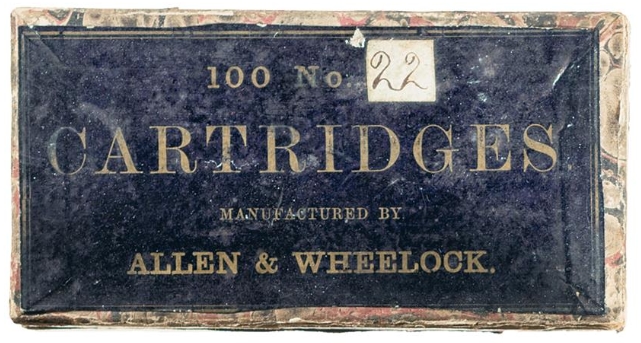
Box of 100 No.22 cartridges - Allen & Wheelock
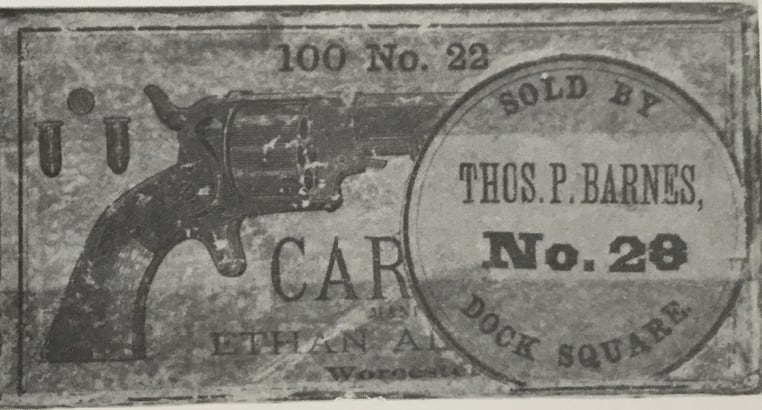
Box of 100 No.22 cartridges - Ethan Allen & Co
Box of 100 No.22 cartridges with image of Allen's Vest Pocket Derringer - Ethan Allen & Co. (B&w picture: the box has black lettering against a light green background)
Box of 100 No.22 cartridges with image of Allen's Sidehammer revolver - Ethan Allen & Co (B&w picture: black letters against a green background)
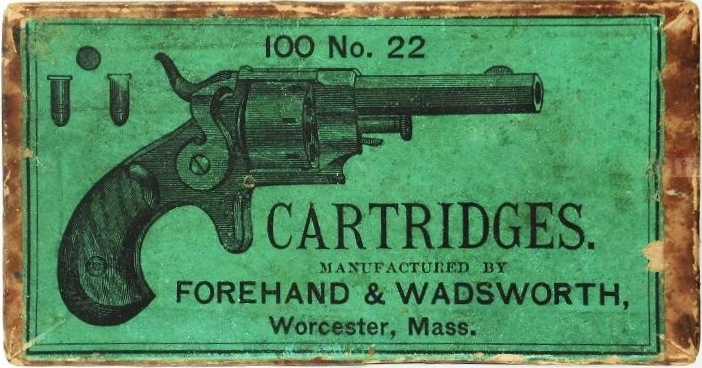
Box of 100 No.22 cartridges with image of Allen's Sidehammer revolver - Forehand & Wadsworth
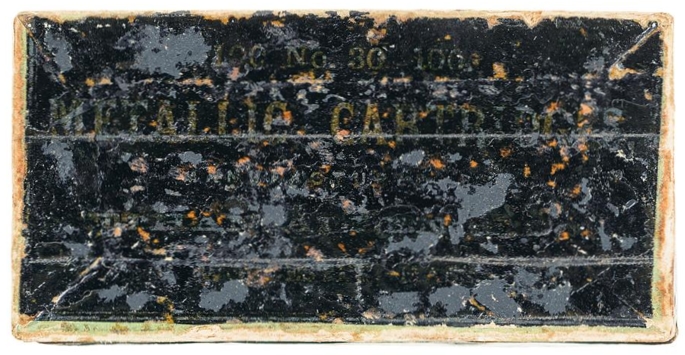
Extremely rare box of 100 No.30 cartridges (22rf with A&W head stamp)- Allen & Wheelock. Unfortunately letters have almost entirely faded.
Box of 50 No.32 cartridges - Allen & Wheelock
Box of 50 No.32 cartridges with image of Allen's Sidehammer revolver - Ethan Allen & Co
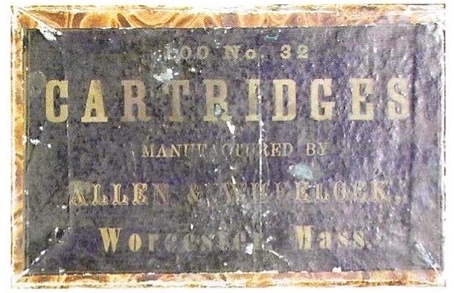
Box of 100 No.32 cartridges - Allen & Wheelock
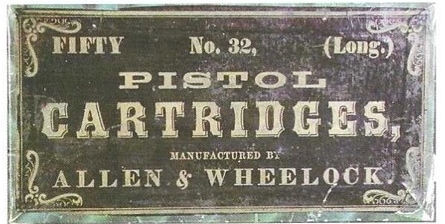
Box of 50 No.32(long) cartridges - Allen & Wheelock
Box of 50 No.41 cartridges with image of Allen's 41RF Derringer - Ethan Allen & Co (B&w picture: black lettering against a green background)
Box of 2 Doz. No.64 cartridges - Allen & Wheelock
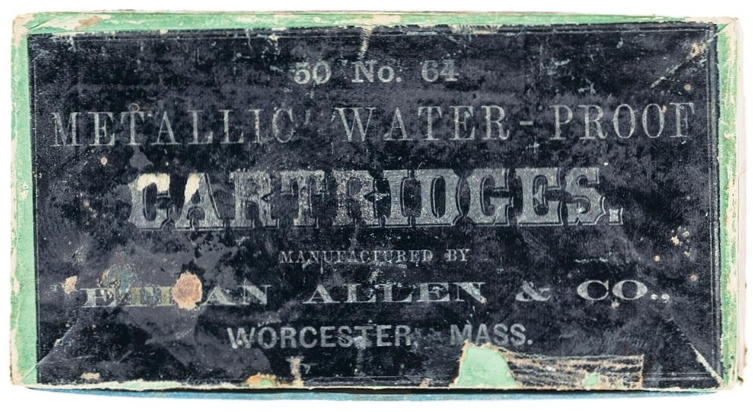
Box of 2 Doz. No.64 cartridges - Ethan Allen & Co
Box of 50. No.44 cartridges - Allen & Wheelock (B&w picture: black lettering agains a light green background)
Pinfire Cartridges
Ethan Allen started the production of the 12 mm pinfire cartridge in 1862, seizing the opportunity that was offered by W. P. Wilstach & Co. to manufacture as a sub-contractor one million cartridges for the U.S. government, with deliveries directly to the Frankford Arsenal. Many of the 11,904 Lefaucheux revolvers purchased by the United States Government for the Union Army during the Civil War eventually found their way into civilian hands after the conflict, creating also a post-war demand for the ammunition.
Aaron Newcomer, a collector and researcher specializing in early 19th-century breech-loading firearm systems, with a particular focus on the pioneering work of Jean Samuel Pauly and Casimir Lefaucheux, has dedicated an article on the Allen & Wheelock Pinfire cartridges. Click HERE to go directly to the article on Aaron’s website.
Box of 2 Doz. 12mm Pinfire cartridges - Allen & Wheelock
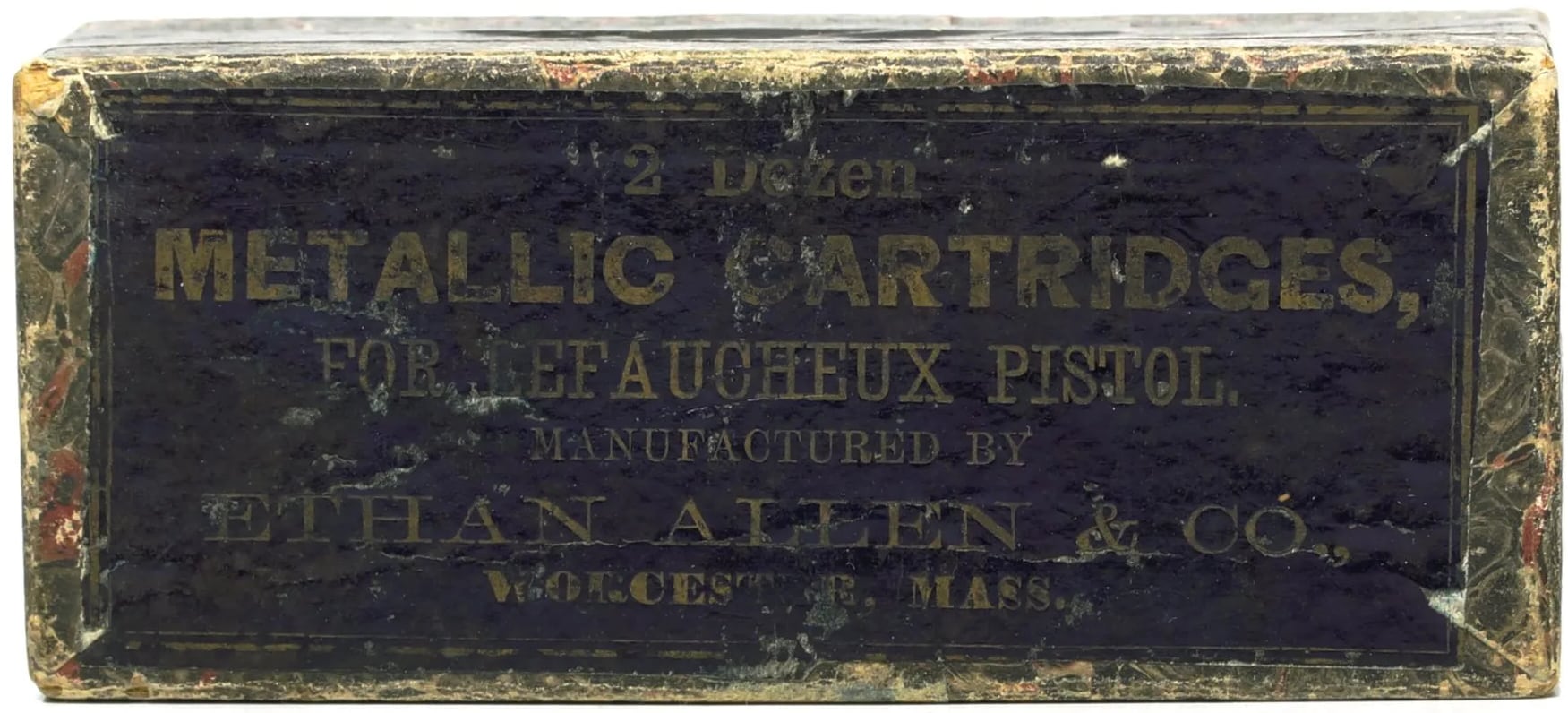
Box of 2 Doz. 12mm Pinfire cartridges - Ethan Allen & Co
A final note
The industrial significance of Allen’s cartridge-heading invention is illustrated by the patent litigation culminating in Union Metallic Cartridge Co. v. United States Cartridge Co., 112 U.S. 624 (1884). [6] Allen’s Patent 27,094 was reissued in 1865, with Reissue 1,948 covering the heading machinery. During proceedings to extend the patent in 1874, the Commissioner of Patents described Allen’s invention as the “first successful organized automatic machine for heading cartridge shells” and noted that its essential principles remained in subsequent high-volume heading machines. The litigation therefore provides strong contemporary evidence of the importance attributed to Allen’s manufacturing innovation.
The Supreme Court case ultimately concerned the scope of Allen’s patent, rather than the significance of his invention. Allen’s original machine used a movable die carrying the cartridge against a stationary heading tool (“bunter”), while the defendant used a stationary die and movable bunter. Because broader language covering this arrangement had been disclaimed during the patent-extension proceedings, the Supreme Court ruled that Allen’s patent could not be interpreted broadly enough to cover the defendant’s machine. The decision thus limited the patent’s legal reach without challenging the historical importance of Allen’s mechanized cartridge-heading concept.
Aaron Newcomer explores the case in an interesting article on his website, offering a revealing glimpse into the workings of the early American patent system and the fierce competition that characterized the rapidly industrializing arms industry. Click HERE to open the article.
References
[1] Ethan Allen, Improvement in Machines for Manufacturing Cartridge-Shells, U.S. Patent 27,094, February 14, 1860. Patent description — US27094A
[2] Ethan Allen, Improvement in Machines for Manufacturing Metallic Cartridges, U.S. Patent 31,695, March 19, 1861. Patent description — US31695
[3] U.S. Census Office, Report on the Manufactures of the United States at the Tenth Census (June 1, 1880), discussion of cartridge manufacture and Allen’s heading machinery. 1880 Census Report on Manufactures