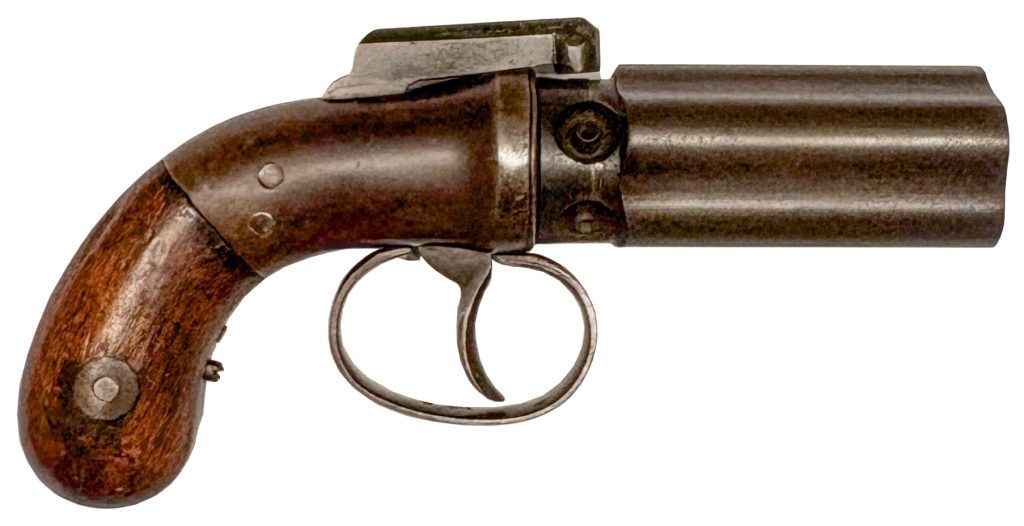
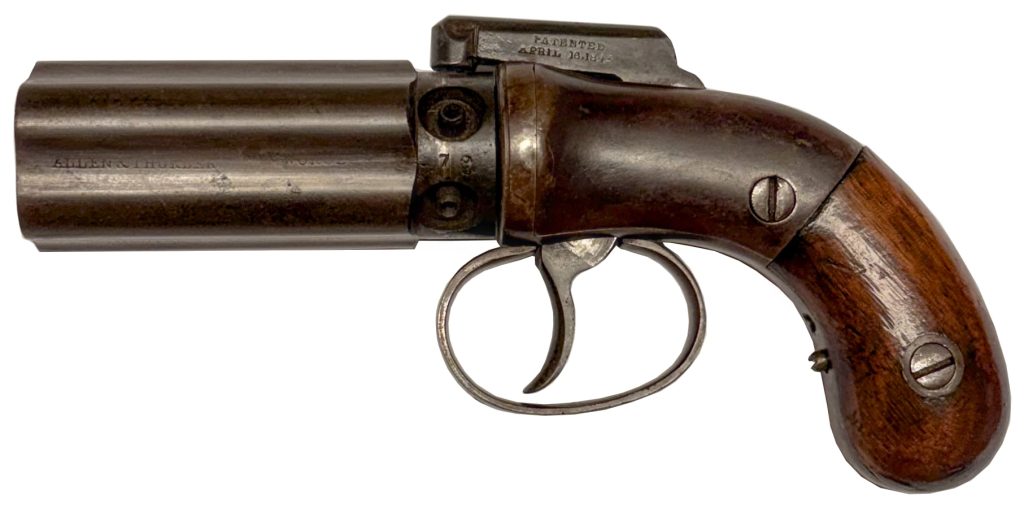
Pepperboxes are the most iconic firearms associated with the legacy of Ethan Allen, and rightfully so. From the late 1830s through the 1850s, the pepperbox dominated the handgun market, bringing Ethan Allen both fame and fortune.
Over more than two decades of production, Allen introduced a remarkable variety of pepperbox models and variants. Unfortunately, the loss of factory records makes it difficult to accurately date specific examples or determine the precise order in which models were produced. Compounding this challenge, Allen marked his guns only with assembly numbers, offering no insight into production sequences or total quantities manufactured.
Further confusion arises from inconsistent and sometimes illogical markings. For instance, many guns bear the 1837 patent marking even though they feature the later 1845 patented system. Many pepperboxes also display only the retailer’s name, with no indication of where the gun was actually made.
To assist in identifying your pepperbox, this page presents an overview of all known Allen pepperbox models. They are organized into four main categories –Dragoons, Standards, Pockets, and Specials- and listed in approximate order of production start, where such information can be determined. For further ease of identification and collectors value estimation, the Flayderman’s guide reference is indicated where available.
For simplicity, this overview does not cover minor variations in hammer or barrel markings. For more detailed information on specific models and production characteristics, please refer to the dedicated pages on the Grafton, Norwich, and Worcester production periods.
The Ring of Pepperboxes
Harley Van Cleave and his son Philip were the pioneers in the 1940’s and 50’s in making an inventory of the many pepperbox types and variations. In their first publication, they introduced the “ring of the pepperboxes” showing 22 distinctive types of 6-shot pepperboxes. In a later publication in the November edition of The Gun Collector”, a revised classification was published with 28 types and 13 sub-types.
Many subsequent studies have refined Van Cleave’s groundbreaking work resulting in the classification you find below. The pepperboxes are organized in four main categories –Dragoons, Standards, Pockets, and Specials- and listed in approximate order of production start, where such information can be determined. For further ease of identification and collectors value estimation, the Flayderman’s guide reference is indicated where available.
For simplicity, this overview does not cover minor variations in hammer or barrel markings.
For more detailed information on specific models and production characteristics, please refer to the dedicated pages on the Grafton, Norwich, and Worcester production periods.
These pepperboxes have some unique features only found on the very first production runs: removeable percussion nipples, a wide back strap (9/16″), patent marking on the side-plate and the internal mechanism lacking the ratchet/pitman system. The barrel cluster has fluted ribs and the grip plates can be found either with or without silver oval inlays. The internal mechanism follows the 1837 patent design.
Flayderman: 5A-013
THE EARLY GRAFTON STANDARD
GRAFTON
Identical to the above with the exception that the ratchet/pitman system has been incorporated. This system remains standard on all subsequent models. Later production see the first use of integral nipples.
Flayderman: 5A-014
THE GRAFTON STANDARD
GRAFTON / Early NORWICH
The pepperboxes now have a narrow back strap and integral nipples—design elements that remained standard on all subsequent models until the end of production. The barrels have fluted ribs, and the internal mechanism follows the 1837 pattern. These pepperbox can be found both with slotted and non-slotted hammers. From early Norwich production, some can be found with narrow flat barrel ribs.
Flayderman: 5A-015 (Grafton production) / 5A-019 (Norwich production fluted ribs) / 5A-021 (Norwich production flat ribs).
THE EARLY SHIELDED GRAFTON STANDARD
GRAFTON
The first appearance of a nipple shield was done on the standard size pepperbox in the late Grafton period. These early nipple shields have a beveled shape. Produced in a very limited quantities, these specimens are extremely rare. Fluted ribs and 1837 patent mechanism.
Flayderman: Not referenced
THE SHIELDED GRAFTON STANDARD
GRAFTON / Early NORWICH
The rolled scroll design nipple shields were introduced in the final days of the Grafton period and carried over into Norwich. Aside from the addition of the nipple shield, these pepperboxes share the same characteristics as the Grafton Standard models and can also be found with sotted and non-slotted hammers. The late Grafton and very early Norwich specimens have the ALLEN’S PATENT hammer marking in small letters while subsequent Norwich production has large letters marking. A rare variant exists with a hexagonal barrel cluster.
Flayderman: 5A-015 (Grafton production) / 5A-020 (Norwich production fluted ribs) / 5A-022 (Norwich production flat ribs)
THE SHIELDLESS DOG-LEG RING-TRIGGER
NORWICH
With this pepperbox, Allen introduced two new design features: the so called dog-leg grip shape and the ring trigger. Beside these two features, these pepperboxes still share the characteristics of the Grafton Standard model including the sotted and non-slotted hammer variants.
Flayderman: 5A-026
THE SHIELDED DOG-LEG
NORWICH
Aside from the addition of the nipple shield, these pepperboxes share the same characteristics as the Shieldless dog-leg model. However, the shielded model came also with a conventional trigger version.
Flayderman: Not referenced
THE SHIELDED DOG-LEG RING-TRIGGER
NORWICH
Identical to the above except for the trigger.
Flayderman: Not referenced
THE SHIELDLESS STANDARD RING-TRIGGER
NORWICH
This model can be considered as the Norwich standard pepperbox. Compared to the Grafton standard, it features a re-designed frame with a substantial longer side-plate. In addition, the fluted barrel ribs are replaced by narrow flat barrel ribs. The internal mechanism still follows the 1837 patent pattern.
Flayderman: Not referenced
THE SHIELDED STANDARD
NORWICH
Aside from the addition of the nipple shield, these pepperboxes share the same characteristics as the shieldless standard models. However, the shielded model came also with a conventional trigger version.
An extremely rare variant exists with an adjustable hammer (a small screw head extends from frame immediately behind hammer)
The introduction of the 1845 patented mechanism was a major improvement. This can easily be seen by the main spring tension screw positioned at the level of the trigger guard.
Flayderman: 5A-028
THE IMPROVED SHIELDED STANDARD RING-TRIGGER
NORWICH
Identical to the above except for the trigger.
Flayderman: 5A-029
THE TRANSITIONAL STANDARD WORCESTER
WORCESTER
This pepperbox is from the early Worcester period and is a slightly modified Shielded standard. It has a different grip angle (semi-dog leg) and the nipple shield has the typical Worcester style engraving.
Flatderman: 5A-044
THE RIBBED WORCESTER STANDARD
WORCESTER
In early Worcester period, Allen introduced a complete new frame profile with a more evenly arched grip. The wooden grip plates no longer included the oval silver inlays. This typical Worcester frame design became the standard across all models through to the end of production. The barrel also changed to more rounded cluster with wide flat ribs.
Flayderman: 5A-045
THE FLUTED WORCESTER STANDARD
WORCESTER
The final design change in the middle of the Worcester period, consisted in a slightly smaller frame and the introduction of a fluted barrel cluster, which became the standard on all other pepperbox sizes and models. In the final days of production, the side plate engraving was often omitted.
Flayderman: 5A-045.5
Dragoon Pepperboxes
The dragoons are massive pepperboxes with significant fire power for the days. Dragoons are always in .36 caliber and the majority of the models have barrel lengths between 5 and 5,5 inches.
THE PRIMITIVE GRAFTON DRAGOON
GRAFTON
These early Dragoons feature fluted barrel ribs and removable numbered percussion nipples. The very early production do not yet incorporate the ratchet/pitman system and have in most cases non-engraved side plates. The grip has a wide back strap (9/16″), and the grip plates can be found either with or without silver oval inlays. The internal mechanism follows the 1837 patent design.
These pepperboxes have a narrow back strap and integral nipples—design elements that remained standard on all subsequent models until the end of production. The barrels have fluted ribs, and the internal mechanism follows the 1837 pattern. The grip is set at a slightly gentler angle compared to the Primitive model. The production started in the late Grafton period and was carried over to Norwich.
Flayderman: 5A-031
THE EARLY SHIELDLESS RING-TRIGGER DRAGOON
NORWICH
Identical to the above except for the trigger. However, the ring-trigger version has only been produced in Norwich.
Nipple shields were introduced on the Dragoons during the Norwich period and featured a rolled scroll design. Aside from the addition of the nipple shield, these pepperboxes share the same characteristics as the earlier shieldless models. However, the shielded models were also produced with barrels featuring narrow flat ribs, associated with later production.
Flayderman: 5A-032 (with fluted ribs) ; the one with flat ribs as shown here is not referenced
THE EARLY SHIELDED RING-TRIGGER DRAGOON
NORWICH
Identical to the above except for the trigger.
Note the sight notches on the barrel of this particular ring-trigger specimen—a rare, non-factory modification added at a later date.
Flayderman: Not referenced
THE IMPROVED SHIELDLESS DRAGOON
NORWICH
The introduction of the 1845 patented mechanism was a major improvement. This can be easily seen by the main spring tension screw now positioned at the level of the trigger guard. All improved models have the narrow flat barrel ribs. I have never encountered an improved shieldless ring-trigger model, but that doesn’t necessarily mean it doesn’t exist…
Flayderman: Not referenced
THE IMPROVED SHIELDED DRAGOON
NORWICH
Aside from the addition of the nipple shield, these pepperboxes share the same characteristics as the improved shieldless models. Production of these models started in the late Norwich period and continued into the early days of the Worcester period. See the Transitional model below.
Flayderman: 5A-036
THE IMPROVED SHIELDED RING-TRIGGER DRAGOON
NORWICH
Identical to the above except for the trigger.
However, contrary to the conventional trigger models, the ring trigger models have not been produced in Worcester.
Flayderman: 5A-038
No picture of a ring-trigger model available.
THE TRANSITIONAL DRAGOON WORCESTER
WORCESTER
From a design perspective identical to the above Improved model. However, the Worcester production models have the rosevine roll engraved nipple shields and Worcester marking on the barrel.
Flayderman: 5A-049
THE RIBBED WORCESTER DRAGOON
WORCESTER
A complete design change with the typical Worcester style rounded grip. A spur is introduced to supply a better grip to these heavy guns. Some rare specimens can be found with a belt hook.
Flayderman: 5A-050
THE FLUTED WORCESTER DRAGOON
WORCESTER
Identical to the above with the exception of the typical Worcester fluted style barrel cluster. These specimens are relatively rare since the production of the dragoons stopped shortly after the introduction of these fluted barrel clusters.
Flayderman: 5A-051
Pocket-Size Pepperboxes
THE DAINTY
GRAFTON
The Dainty is considered the first model ever produced. The Dainty has all the characteristics of the initial production: removable percussion nipples, no ratchet/pitman system and a wide back strap (9/16″). Grip plates can be found either with or without silver oval inlays. The internal mechanism follows the 1837 patent design and the barrel has fluted ribs. Production of this model was discontinued rather quickly, and pocket-sized pepperboxes did not reappear until the Worcester period.
Flayderman: 5A-012
THE SHIELDED FIVE SHOT
WORCESTER
A quite compact pepperbox. Mechanically identical to the standard Worcester pepperbox, but with a casted nipple shield as part of the frame. They can be found bearing all three of the company’s markings from the Worcester era.
Flayderman: 5A-040
THE SHIELDLESS FIVE SHOT
WORCESTER
A downgraded version of the five-shot omitting both the nipple shield and the decorative engraving. It was produced during the final days of pepperbox manufacturing and is found only with Allen & Wheelock markings.
Flayderman: 5A-041
THE TRANSITIONAL SHIELDLESS FIVE SHOT
WORCESTER
When the shieldless frame was introduced, a number of barrels for the shielded version with the milled rebate were still on stock. These were fitted to the shieldless frame. For these to be originals, the numbers should match.
Flayderman: 5A-041.5
THE FOUR SHOT
WORCESTER
These compact pepperboxes are the smallest models produced by Allen, introduced during a period when revolvers had already overtaken pepperboxes in the firearms market. The design introduced a new way of fixing the barrel cluster using a freely rotating screw at the rear of the frame. This pepperbox is the only model to bear the 1857 patent date on the hammer. The frame is typically engraved, though engraving was omitted in final production runs.
Flayderman: 5A-042
Special design Pepperboxes
THE HAMMERLESS
NORWICH
The hammerless- or concealed hammer pepperbox with a distinctive design was introduced during the Norwich period. In this model, the percussion nipples are aligned in-line with the barrels, and the hammer mechanism is fully enclosed within the frame. The barrel clusters are in most cases, shorter than those found on standard pepperboxes.
Flayderman: 5A-023
No picture of a hammerless with conventional trigger available.
THE HAMMERLESS RING-TRIGGER
NORWICH
Identical to the above except for the trigger.
Flayderman: 5A-024
THE IMPROVED HAMMERLESS
WORCESTER
Identical to the above but with the simplified internal mechanism following the 1845 patent principles. Another small improvement is the lip extension on the top of the frame to cover the top nipple. The improved hammerless is only produced in the early Worcester period in very limited numbers and only with a conventional trigger.
Flayderman: 5A-047
THE SINGLE ACTION DRAGOON
WORCESTER
This single action dragoon is a very unique piece. Factory records indicate only twelve single actions dragoons were ever made in the early Worcester period, so we can conclude that this was an experimental gun.
Flayderman: Not referenced
THE SINGLE ACTION
WORCESTER
Another unusual and relatively rare single action from the Worcester production period. The internal works are completely different from the double actions, which explains the absence of the 1837 patent date markings. The single action failed to gain popularity and production remained limited.