
Patent 461
It all started with this patent. It describes the mechanism for firing the pistol by simply pulling the trigger, thus eliminating the need to cock the hammer first. The trigger is connected to the hammer via a tumbler. By pulling the trigger the hammer gets cocked until the moment the tumbler releases the hammer. Under the pressure of the main spring, the hammer falls back to the initial position, causing the shot to be fired. This double action system was a true revolution for this time. The Tube Hammer pistol is the first gun to use the system and gives Ethan Allen his first commercial success. The same mechanism is used in all Bar Hammer pistols and pepperboxes that Ethan Allen subsequently puts on the market.

Patent 3998
The patent describes an improvement of the 461 patent mechanism using only the mainspring to operate the hammer, the dog, and the trigger, simplifying the lock mechanism significantly by eliminating two springs. The patent also outlines a new improved method for revolving the barrel cluster, using a pitman and ratchet (a series of angular teeth on the back of the barrel cluster.

Patent 16367
This patent describes 3 distinct improvements in revolver design: an improved cylinder support, a better ignition system, and a new type of loading mechanism. It uses a conical support to hold the rotating cylinder securely while allowing smooth rotation. A valve near the nipple controls the ignition flow, improving efficiency and preventing gas loss. The design also includes a lever-operated rammer integrated with the trigger guard for loading. Overall, the improvements enhance reliability, durability, and firing performance and will be applied by Allen on various models.

Patent 18836
This patent describes an improved revolver mechanism that enhances how the cylinder is rotated and locked in position. It introduces a separate rotating plate with ratchet teeth and locking recesses attached to the rear of the cylinder. A coordinated system of catch, tumbler, and lock-pin ensures precise timing of rotation and secure alignment with the barrel. The design prevents misalignment and over-rotation while maintaining reliable indexing. However, the main novelty is the specific shape of the plate and the way the cylinder can be removed in a closed frame revolver design.

Patent 21400
This invention improves revolvers by addressing gas leakage and safety issues at the cylinder-barrel junction. A specially shaped center pin deflects escaping gases to prevent fouling that would hinder cylinder rotation. Additional protective guards are added around the front of the cylinder to shield the user’s hand from escaping gas or accidental discharge. The design improves reliability by reducing clogging and enhances user safety.

Patent 22005
This invention is an improved revolver mechanism focusing on cylinder rotation and internal support of the firing components. It uses a cam system connected to the tumbler to advance and lock the cylinder precisely during cocking. A pivoted piece engages cavities in the cylinder to rotate and secure it in position. The design also strengthens the frame by integrating the hammer support pin.

Patent 28951
A simple and smart improvement to rimfire revolvers modifying the recoil-plate behind the cylinder. It introduces an inclined projection that reduces pressure from the cartridge after firing. This prevents binding between the cartridge and the recoil surface. As a result, the cylinder can rotate more freely during operation. The design enhances reliability and smooth functioning of the firearm.

Patent 33328
An improvement in securing and removing the cylinder pin more conveniently. A lever-catch mechanism is introduced at the front of the frame to lock the cylinder pin in place. The same lever allows the user to release and remove the pin easily using the thumb. The design simplifies disassembly for loading and maintenance. Additional features include a geared ejector system for removing spent cartridge cases.

Patent 33509
This invention is an improvement in revolvers focusing on the interaction between the trigger and cylinder stop mechanism. The design allows the trigger to directly operate the stop that locks the cylinder in place. As the trigger is pulled, it disengages the stop, allowing the cylinder to rotate to the next chamber. After rotation, the stop re-engages to secure alignment for firing. This simplifies the mechanism and improves timing and reliability.

Patent 46617
An automatic cartridge extraction system for single-shot pistols. It uses a pivoting barrel that, when opened, actuates a linked extractor mechanism. This mechanism pushes or ejects the spent cartridge case from the chamber. The system simplifies reloading by combining opening and extraction into a single motion. Overall, it improves efficiency and ease of use in breech-loading pistols.

Patent 13154
This invention is an improved breech-loading firearm using a rotating breech-block with an integrated charge chamber. A lever rotates the block to align the chamber with the barrel for loading, then closes it to seal the breech. During closing, the mechanism bends and breaks the cartridge, exposing the powder for ignition. The design also uses the force of firing to tighten and seal the breech joints. Additionally, the breech-block helps keep the chamber clean and reduces fouling.

Patent 30033
The patent describes a breech-loading firearm with a sliding breech-piece for loading metallic cartridges. It incorporates an extractor mechanism that is automatically actuated by the same lever used to open the breech. As the breech is lowered, a spring-loaded discharger engages the cartridge rim and ejects the spent case. This allows both opening and extraction to occur in a single motion. The design improves speed, simplicity, and reliability in reloading.

Patent 35067
This invention improves revolvers with multiple mechanical refinements to loading, operation, and maintenance. It introduces a safer loading gate with a locking lip, an improved cartridge ejector pin that engages the rim more effectively, and a more efficient cylinder-rotating lever. It also includes an adjustable hammer notch controlled by an external screw. Additionally, a rack-and-pinion mechanism allows easy removal of the cylinder pin.

Patent 36760
A practical rear sight for rifles using a rotating disk mechanism. The disk contains multiple holes arranged so that each position corresponds to a different elevation. As the disk is turned, a new hole aligns with a vertical slot, raising or lowering the line of sight. The numbered positions allow the shooter to quickly select a known setting for specific distances. The design enables precise, repeatable adjustments for aiming.

Patent 49491
This invention is a double-barrel breech-loading firearm with an improved opening and locking mechanism. A horizontally rotating lever both unlocks and assists in opening the hinged breech. The system includes a spring-loaded locking bolt to secure the breech firmly when closed. A central extractor simultaneously removes both cartridge cases using a rack-and-sector mechanism. The design improves strength, ease of operation, and reliability in breech-loading double-barrel guns.

Patent 84929
This patent describes a set of improvement to double-barrel breech-loading firearms. It strengthens the connection between barrels and breech using an integrated extension and dovetail joint. A hinged breech with a separate but linked locking mechanism improves secure closure and ease of operation. The trigger guard also functions as an extractor lever for cartridge removal. Additionally, a removable auxiliary rifled barrel allows the gun to fire both shot and ball, combining shotgun and rifle capabilities.

Patent 15454
This invention is an improved bullet mold for casting hollow projectiles such as Minié balls. It introduces a mechanism that cuts off the sprue (excess metal) cleanly during the molding process. The mold includes a rotating core and cutter that shape the interior cavity while trimming the sprue flush with the bullet surface. This eliminates the need for additional finishing operations. It also prevents the bullet from sticking in the mold and ensures consistent, symmetrical results.

Patent 27094
This patent describes an improved machine for making rimfire cartridges cases efficiently and uniformly. The invention automates trimming and forming cap cases, ensuring they are cut to exact length and shaped with a hollow rim in one stroke. It uses a combination of sliding mandrels, revolving chucks, and automatic cutting tools for precise, synchronized motion. This design replaces slower spinning methods, producing consistent, ready-to-load rimfire cases in a single mechanical cycle.

Patent 30109
This invention describes the so-called lipfire cartridge design featuring a projecting lip at the base. The lip holds the fulminate (primer compound) instead of distributing it across the entire base. This reduces the amount of explosive material needed and according to Allen, lowers the risk of failure. The design also strengthens the cartridge head and prevents deformation during firing. Overall, it improves safety, efficiency, and durability of cartridges.

Patent 31695
This invention is a machine for manufacturing metallic cartridges by shaping and finishing the bullet end. It uses rotating rollers to compress the cartridge material around the bullet and form grooves for lubrication. Cutting tools trim excess material during the same process. A clamping mechanism holds the cartridge securely while the operations are performed. The system automates multiple steps, improving speed, consistency, and precision in cartridge production.
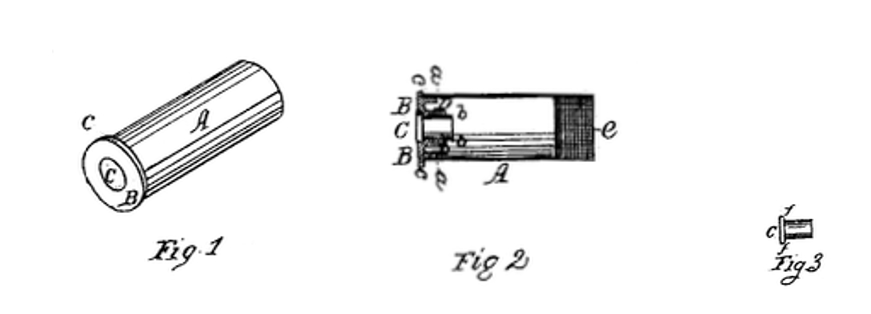
Patent 47688
This invention is a reusable metallic cartridge shell designed for better ignition and safety. It features a base with multiple flanges to securely hold the primer cap and prevent gas escape. The inner surface of the shell is grooved or roughened to keep the powder and wad from shifting. Ignition begins near the projectile and burns backward for more efficient firing. The cartridge is reloadable, with the primer cap easily removed and replaced.

Patent 2912
This invention is a mechanical engraving machine that copies designs by linking a tracing pointer to a cutting tool (graver). As the pointer follows a pattern, the graver reproduces it onto metal. The system uses gears, cranks, and sliding frames to control motion and ensure precision. A ratchet mechanism advances the work step-by-step for full coverage. The machine can engrave flat, round, or cylindrical surfaces by adjusting the setup. It improves speed, accuracy, and consistency compared to manual engraving.

Patent 27415
This patent describes a machine for forming locking notches or catches on the cylinders of revolvers and similar firearms. The invention automates the cutting or pressing of cylinder notches—those small recesses that engage the revolver’s locking bolt for chamber alignment. It uses a system of arbors, indexing plates, and an inclined support to guide a cutting tool that shapes the beveled notches with precision. Allen’s design allowed for faster, more uniform production of revolver cylinders, improving accuracy and manufacturing efficiency.

Patent 48249
This invention relates to the construction of gun barrels using layered iron and steel. The materials are welded together, twisted, flattened, and then split and reassembled before being formed into a barrel. This process creates distinctive decorative patterns on the barrel surface. At the same time, it enhances structural strength through layered construction. The result is a barrel that is both durable and visually distinctive.

Patent 55596
This invention is a method and apparatus for heating and soldering gun barrels more efficiently. It uses a fire-box and air blast system to force heat directly through the interior of the barrels. Single and double nozzles allow heating of one or two barrels at a time. Clamps hold paired barrels securely during soldering. The process provides faster, more even heating and improves manufacturing efficiency compared to traditional methods.