Norwich Era Pepperboxes - 1842 to 1847

Commercial era:

Allen & Thurber

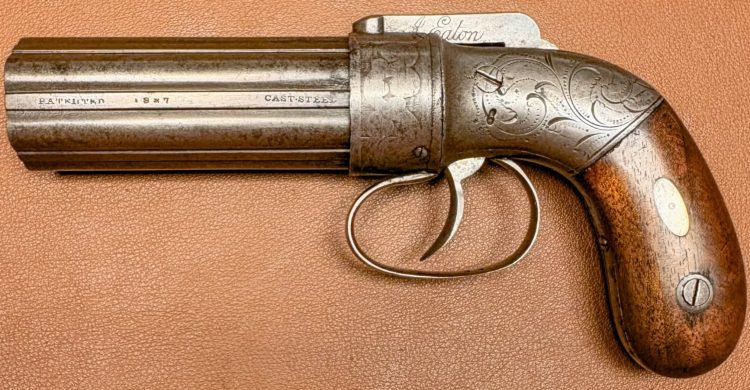
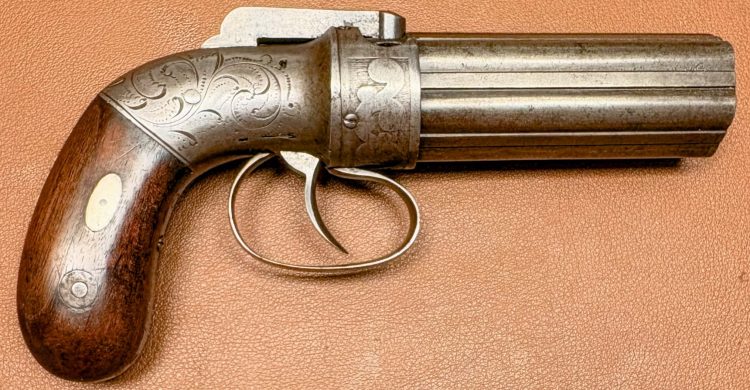
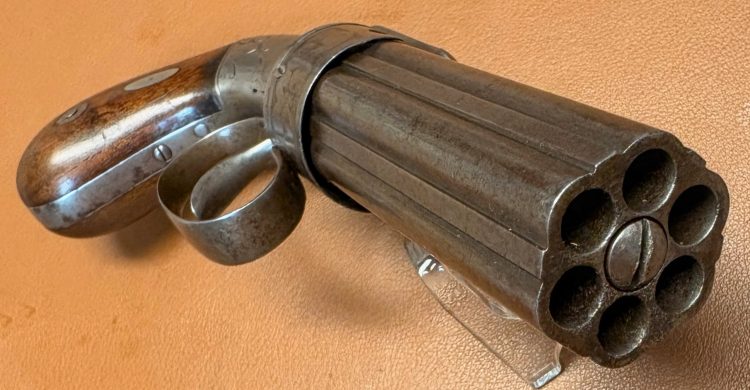
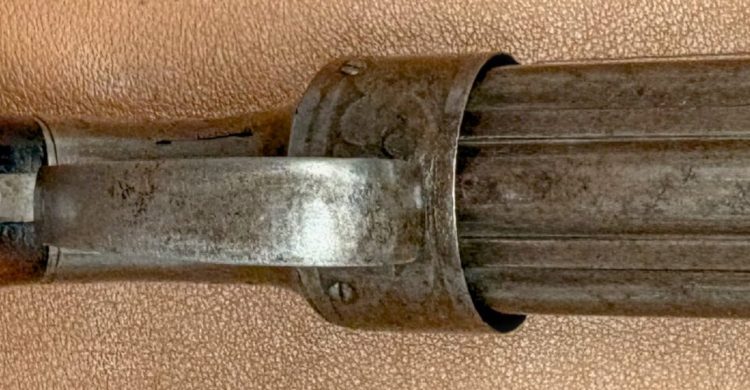
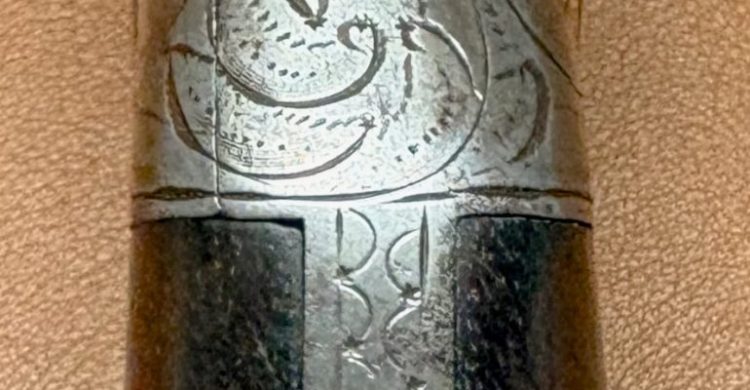
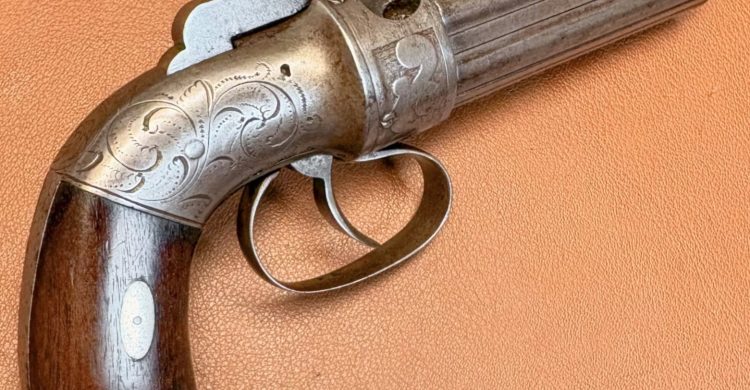
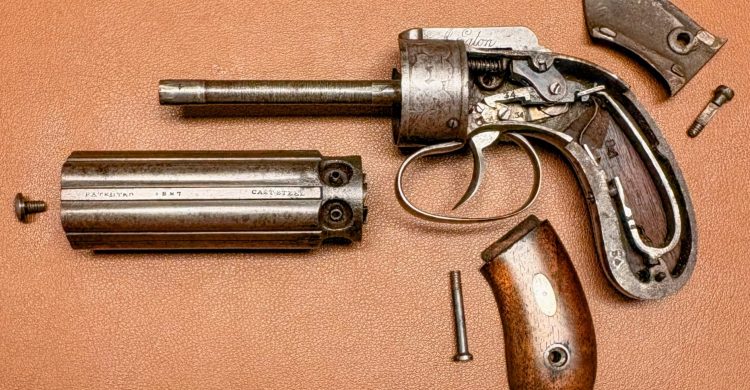
Although only the standard and dragoon-sized pepperboxes were produced during the Norwich period, Ethan Allen successfully designed and manufactured an impressive variety of pepperbox models and variations. Since production transitioned from the Grafton facility, it’s understandable that pepperboxes from the early Norwich period (1842–1843) retain the style and characteristics of the late Grafton models: the 1837 patented action, the fluted barrel ribs, the quick drop grips and the silver oval inset grip decorations. In the final phase of the Grafton period, Allen introduced a nipple shield featuring simple rolled scroll engraving. This design grew in popularity during the Norwich period, leading to the gradual replacement of unshielded models with shielded ones. Later Norwich production saw significant additional stylistic changes, including the adoption of dogleg shaped grips, narrow flat barrel ribs, and notably, the introduction of the improved 1845 patented action.

The ring trigger was another feature introduced as an alternative to the conventional trigger, probably inspired by the European pepperboxes of the era. Approximately one-third of all Norwich pepperboxes were made with slotted hammers (a narrow slit through the hammer) intended to serve as a rudimentary rear sight when the hammer was cocked, a feature that offered little practical advantage. 

Norwich style shield
Slotted hammers: Early "small" and later "big" letter marking
Standard hammer marking left side

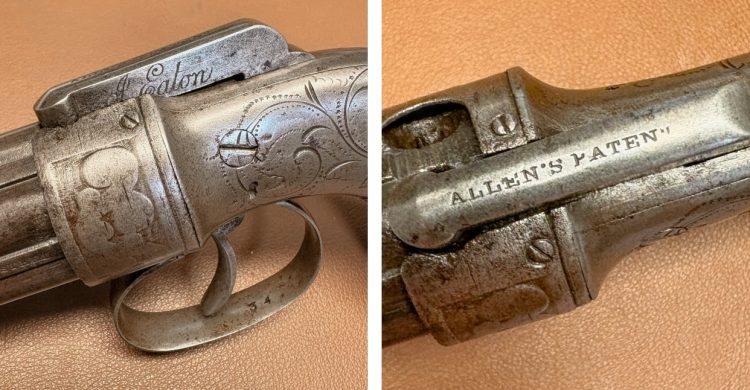
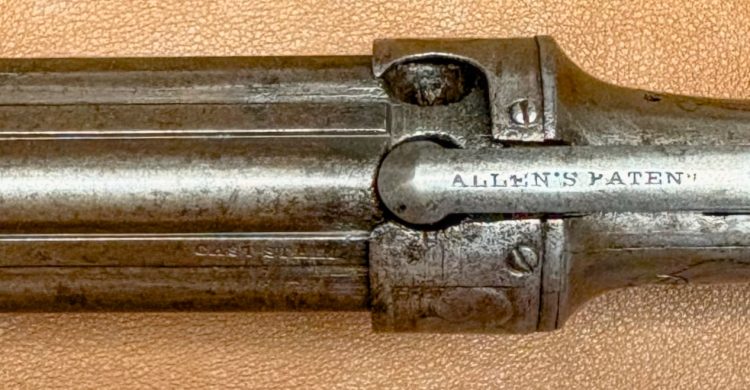
Hammer and barrel markings serve as key indicators in identifying the production period. During the early Norwich period, the “Allen’s Patent” marking on the hammer was applied using small letter dies (The so-called No.1 die -1.5mm in letter height). Around 1844, these were replaced with the No.2 die (2.5mm letter height), offering a useful reference point for dating these firearms. Additionally, the standard barrel marking “Patented / Caststeel” found on early Norwich pepperboxes did not include the patent date. It’s likely that the inclusion of the patent date began after the 1842 law mandated the patent date display. Notably, the earliest die featuring the patent date used a flat-topped ‘3’, while later dies adopted a rounded-topped ‘3’, providing another clue for identifying production timelines.

It’s also worth noting that after the introduction of the improved 1845 action, the updated die reflecting this new patent was slow to arrive. As a result, the entirety of Norwich pepperboxes featuring the 1845 action continued to be marked with the older 1837 patent date dies. Below four distinct variants of the barrel markings.

  • The standard marking.
  • A rare and striking variant where the patent date is stamped upside down, likely due to an operator orientation error during production.
  • A marking made with worn dies, where the ‘3’ appears “broken”—a result of extensive die use on fluted ribs.
  • A flat-topped ‘3’ in the patent date
Lastly, many pepperboxes were distributed through a widespread network of retail agents. These firearms were often marked with the name of the retail agent, typically stamped on the left side of the hammer, and in rarer instances, on the barrel cluster.

The Norwich period also witnessed the introduction of an entirely new design—the concealed hammer pepperbox. In this model, the percussion nipples were aligned directly with the barrels, and the hammer mechanism was fully enclosed within the frame. While innovative, this design did not achieve significant commercial success, resulting in limited production. As a result, concealed hammer pepperboxes are exceptionally rare and highly sought after by collectors today.

Here are some typical examples of Norwich-era pepperboxes that highlight the evolution and variety of features during this period

A cased, shieldless dragoon ring trigger pepperbox from the early Norwich period, featuring fluted barrel ribs—characteristic of Grafton and early Norwich production. This particular model represents one of several variations; the same pepperbox was also manufactured with a conventional trigger, both in shieldless and shielded configurations.

This is the standard pepperbox from the early Norwich period, featuring the 1837 action, fluted barrel ribs, and a slow drop grip—a configuration closely mirroring the late standard models from the Grafton period. However, a key distinguishing feature of these early Norwich examples is that they are most often equipped with a nipple shield, marking a gradual evolution in design while retaining many earlier stylistic elements.

This is a standard size ring trigger pepperbox dating from mid-way through the Norwich period. It features a full dogleg grip, indicating a shift in grip design from earlier models. Despite this evolution in form, the pepperbox still utilizes the 1837 patent action, identifiable by the distinctive placement of the mainspring tension screw. This model was also produced with a conventional trigger.

This is a concealed hammer pepperbox with a ring trigger, a distinctive design introduced during the Norwich period. In this model, the percussion nipples are aligned in-line with the barrels, and the hammer mechanism is fully enclosed within the frame, giving it a cleaner, more compact profile. These pepperboxes were also available with a conventional trigger. The barrel clusters on concealed hammer pepperboxes were, in most cases, shorter than those found on standard pepperboxes.

This is a shielded dragoon pepperbox featuring the 1837 action, fluted barrel ribs, and a conventional trigger. It stands out with its finely engraved silver grips, adding a touch of elegance and craftsmanship. The hammer is marked with the retail agent name “BOLEN NY”

This is a magnificently decorated, cased standard-size pepperbox is from having the 1845 action and narrow flat barrel ribs. It is fitted with elegant ivory grips, adding to its luxurious appearance. Such deluxe versions of Allen pepperboxes are exceptionally rare, produced for high-end clientele or as presentation pieces. 

This is another beautiful deluxe engraved version of the standard-size pepperbox with ivory grips and a silver nipple shield. The pepperbox is from the late Norwich period with the 1845 action and narrow flat barrel ribs.

This dragoon-size pepperbox is also from the late Norwich period, equipped with the improved 1845 patent action and narrow flat barrel ribs. While this example is shown with a conventional trigger, it was also available with a ring trigger, offering buyers a choice in configuration.

All the variations and model differences make the Norwich period arguably the most complex and challenging era for collectors. To gain a clearer understanding of the production during this time, I’ve created a simplified table overview of the different models observed. The categorization is based primarily on system type, followed by trigger type, barrel rib style, presence of a nipple shield, and grip style.

To keep the overview accessible, I’ve intentionally excluded sub-variants such as barrel lengths, caliber differences, specific markings, and hammer types

Standard-size pepperboxes with 1837 patented system

Trigger Type Barrel Rib Type Nipple cover Grip type
Conventional
Fluted
Shieldless
Quick drop
Conventional
Fluted
Shielded
Quick drop
Conventional
Fluted
Shielded
Dog leg
Conventional
Narrow flat
Shieldless
Quick drop
Conventional
Narrow flat
Shielded
Quick drop
Conventional
Narrow flat
Shielded
Dog leg
Ring
Fluted
Shieldless
Dog leg
Ring
Fluted
Shielded
Dog leg
Ring
Narrow flat
Shieldless
Quick drop
Ring
Narrow flat
Shielded
Quick drop

Standard-size pepperboxes with 1845 patented system

Trigger Type Barrel Rib Type Nipple cover Grip type
Conventional
Narrow flat
Shielded
Quick drop
Conventional
Narrow flat
Shielded
Dog leg
Ring
Narrow flat
Shieldless
Quick drop
Ring
Narrow flat
Shielded
Quick drop

Dragoon-size pepperboxes with patented 1837 system

The dragoon pepperboxes have only been produced with the quick drop grip type.

Trigger Type Barrel Rib Type Nipple cover
Conventional
Fluted
Shieldless
Conventional
Fluted
Shielded
Conventional
Narrow flat
Shieldless
Ring
Fluted
Shieldless
Ring
Narrow flat
Shieldless
Ring
Narrow flat
Shielded

Dragoon-size pepperboxes with 1845 patented system

Trigger Type Barrel Rib Type Nipple cover
Conventional
Narrow flat
Shielded
Ring
Fluted
Shielded
Ring
Narrow flat
Shieldless
Ring
Narrow flat
Shielded

Classification of the Concealed hammer pepperboxes

These pepperboxes come only in one size. All have the 1837 type of system (tension screw low on the grip) and have the Dog leg style grips.  There are some specimens know with 1845 system, but these dates from the Worcester era.

Trigger type Barrel rib type
Conventional
Narrow flat
Ring
Narrow flat
COLLECTION PIECES

The Shielded Grafton Standard - Bolen marking

  • Caliber:

    32

  • Assembly number:

    42

  • Length:

    Barrel:8,3 cm (3,27"), Total:16,6 cm

  • Weight:

    575 gr

  • Hammer marking (Left):

    J.G.BOLEN,N.Y.

  • Hammer marking (Top):

    ALLEN'S PATENT

  • Barrel marking:

    BOLEN 104 B.WAY N.Y.

From the P.O. Collection 

This pepperbox retains the characteristic frame design and fluted barrel ribs associated with the Grafton era. However, the  patent marking stamped on top of the hammer using the No.2 die identifies it as an early Norwich-production example. As such, it can be regarded as a transitional piece between the two production periods.

Bolen is by far the most commonly encountered retailer marking on these pepperboxes. In addition to the standard Bolen marking on the hammer, this example also bears the much scarcer Bolen barrel marking, complete with the New York address.

The Shielded Standard - Hyde & Goodrich marking

  • Caliber:

    30

  • Assembly number:

    8

  • Length:

    Barrel:9,4 cm (3,7"), Total:17,9cm

  • Weight:

    603 gr

  • Hammer marking (Left):

    HYDE & GOODRICH / NEW ORLEANS

  • Hammer marking (Top):

    ALLEN'S PATENT

  • Barrel marking:

    PATENTED 1837 CASTSTEEL

This is a standard shielded six-shot pepperbox in .30 caliber. It has the typical Norwich characteristics, including the prolonged side plate and the slightly more gradual grip angle when compared to the transitional Grafton example shown above. The hammer is marked with the rare Hyde & Goodrich / New York retail agent marking.

Also note the transition from the earlier fluted barrel ribs to the narrower flat ribs seen on this example, a feature characteristic of Norwich production.

The Shielded Standard Ring-Trigger - Spies marking

  • Caliber:

    31

  • Assembly number:

    5

  • Length:

    Barrel:9,7 cm (3,8"), Total:17,1cm

  • Weight:

    580 gr

  • Hammer marking (Left):

    A.W.SPIES / ALLEN'S PATENT

  • Barrel marking:

    PATENTED 1837 CASTSTEEL

This is another standard shielded six-shot pepperbox, this time chambered in .31 caliber and configured with a ring trigger. Its internal mechanism is based on the 1837 patent action, while the hammer bears the No.1 die “Allen’s Patent” marking, dating the piece to approximately 1843. The walnut grips are fitted with an oval silver escutcheon.  The the hammer is further marked A.W. Spies, identifying the New York retail agent.

The pepperbox is attractively housed in a fitted case and accompanied by a set of original accessories, including a ramrod, bullet mold, and powder flask.


The Shielded Standard Ring-Trigger - Young & Smith marking

  • Caliber:

    32

  • Assembly number:

    20

  • Length:

    Barrel:8,3 cm (3,25"), Total:17,8 cm

  • Weight:

    586 gr

  • Hammer marking (Left):

    YOUNG & SMITH N–Y / ALLEN'S PATENT

  • Barrel marking:

    PATENTED 1837 CASTSTEEL

From the P.O. Collection 

This pepperbox is virtually identical to the specimen described above, with the notable exception that its barrel cluster retains the earlier fluted ribs. This feature places it slightly earlier in production, most likely dating it to the first or second year of manufacture in Norwich.

The pepperbox has the scarce New York retail agent marking Young & Smith.

Â