Retail Agents - Hammer and barrel markings
On early pepperboxes and barhammer pistols
Ethan Allen distributed a significant portion of his pepperboxes and pistols through an extensive network of retail agents. Firearms from both the Grafton and Norwich periods often bear the names of these agents, typically stamped on the hammer and, more rarely, on the barrel cluster.
The most frequently encountered markings are those of prominent New York agents J.G. Bolen and A.W. Spies, whose names are commonly found on surviving examples. These agent markings not only provide valuable context for the firearm’s original point of sale but also add to their historical and collector value.
However, Allen pepperboxes or pistols bearing markings from retail agents other than Bolen and Spies are extremely rare.
Below you can find an overview of the agent hammer and barrel markings I have personally observed.
If you own an Allen pepperbox or pistol with a retail agent marking not listed here, and would be willing to contribute to this research, I would greatly appreciate it if you could share a photo of the marking for possible inclusion on this page. Please feel free to get in touch via the contact form.
Other known agents:
- Young & Smith
- Lane & Read
- Tryon
- Hyde & Goodrich
- J. Eaton
- Meade & Adriance
- Canfield Bro’s
- S. Sutherland
- Wolf & Gillespie
- P. Evens
John G. Bolen
104, Broadway
New York
John George Bolen (1809–1888) was an active figure in New York’s firearms trade during the mid-19th century. From 1834 to 1850, he was listed in city directories as an engraver, printer, and gunsmith.
Beginning in 1851 and continuing through 1857, his listings shifted to identify him solely as a gunsmith or dealer in guns and pistols. According to period records, Bolen relocated in the early 1840s from 66 Green Street to 104 Broadway, where he continued his business until 1858. His name appears frequently on Allen pepperboxes, making him one of the most commonly encountered retail agents associated with these firearms
Hammer markings:
Hammer markings:
Barrel markings:
Adam W. Spies
192 Pearl Street
New York
moved in 1840 to
218 Pearl Street
moved in 1846 to
91 Maiden Lane
and in 1859 to
187 Broadway
As evidenced by this newspaper announcements, Adam W. Spies (1800–1891) established his own retail business in 1833. He successfully operated for three decades, closing the business in 1863. Spies likely became a retail agent for Ethan Allen as early as 1836 or 1837, as his name appears the pocket rifle pistols and on Grafton-era pepperboxes—making him one of Allen’s earliest and most prominent distribution partners.
Hammer markings:
William Buckingham Canfield (1809–1883) was a silversmith and jeweler who, from 1835 to 1865, partnered with Ira and Jared H. Canfield in Baltimore, MD, under the name CANFIELD & BROTHER.
The firm operated as a typical 19th-century retail establishment, offering a broad range of goods to the public—as reflected in the advertisement. While firearms were evidently among the items sold, the gun trade appears to have been a minor side activity, as it was not mentioned in the advertisement. Nonetheless, the appearance of the Canfield & Brother marking on Allen pepperboxes provides intriguing evidence of their involvement in firearm retail, albeit on a limited scale.
Hammer markings:
Hyde & Goodrich
15, Chartres street
New Orleans
James N. Hyde established his retail business in New Orleans in 1817. A few years later, his brother-in-law Charles Whiting Goodrich joined him, forming the well-known firm Hyde & Goodrich.
Originally located on Chartres Street, the store moved in 1853 to a prominent location at the corner of Canal and Royal Streets.
Hyde & Goodrich operated as a high-end retail establishment specializing in “fancy goods.” Their offerings included an array of luxury and practical items such as watches, jewelry, silverware, pens, and firearms.
Hammer markings:
Lane & Read
6, Market square
Boston
Lane & Read operated as a firearms dealer from 1826 to 1849, specializing in guns produced in and around the Boston area. The business was originally located at 6 Market Square in Boston and later relocated in the 1850s to 107 Washington Street.
After Edward Lane left the partnership in 1849, the business continued under the name William Read & Sons, maintaining operations well into the early 20th century.
Hammer markings:
Samuel Sutherland
132, Main street
Richmond, Virginia
Samuel Sutherland (1813–1877) founded a gunsmithing and firearms manufacturing business in Richmond, Virginia, during the 1840s. Operating under the trade name “Southern Importing House,” Sutherland became a prominent figure in the Southern arms trade and earned the nickname “Armorer of the South.”
While he initially focused on retail and gunsmithing, his operations expanded significantly during the Civil War, when he ran a large facility primarily dedicated to altering flintlock firearms and reclaiming damaged weapons for the Confederate military.
Edward K. Tryon
134, Second Street, Philadelphia
George W. Tryon established his firearms business in 1811, founding a firearms house that would endure for over a century and span four generations. A major reorganization occurred in 1836, when the company separated its manufacturing operations from its general merchandise division. That same year, Edward K. Tryon, George’s eldest son, was brought into the partnership, and the firm formally adopted the designation: “Manufacturers, Importers and General Dealers in Fire Arms.”
In the early 1840s, the firm introduced its iconic Golden Buffalo logo, which quickly became a recognized symbol of the Tryon name and the quality of its manufactured goods—gaining international recognition.
For those interested in a comprehensive account of the Tryon legacy, including its role in the American arms trade, I highly recommend reading the detailed article published by the American Society of Arms Collectors 100 Years of Tryon.
Barrel markings:
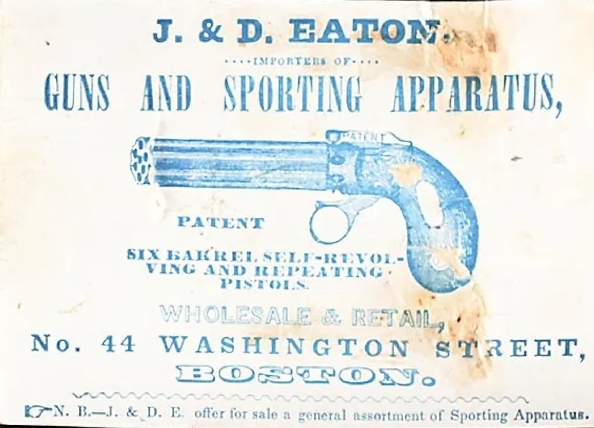
James Eaton
Boston, Mass.
James Eaton (1814–1882) began his gunsmithing career in Concord, New Hampshire, in 1835. He successfully operated his business there until 1843, when he sold the company and relocated to Boston. There, he continued his work in gunsmithing and firearms trade under the name J. Eaton & Company.
Eaton remained active in the Boston firearms scene until 1853. Although a significant number of pepperboxes were sold through J. Eaton & Company, examples actually bearing the J. Eaton marking are extremely scarce. This rarity suggests that only a limited number were custom-marked with his name—making such specimens particularly desirable and noteworthy among collectors.
Hammer markings:
Young & Smith
New York
In the 1820s and 1830s, Henry Young (1792-1874) operated a hardware and military goods store at 4 Maiden Lane, as listed in Longworth’s Business Directory under “Young, Henry, hardware & military store.” Around 1834, he formed a partnership with William Henry Smith, establishing Young, Smith & Co. at the same location. In the following two decades the company went through a sequence of name changes: 1844 – Young & Smith ; 1845 – Wm. H. Smith & Co. ; 1854 – Smith, Young & Co. ; 1858 – Young, Smith & Co.
Hammer markings:
We can conclude that all pepperboxes marked in this manner are dated 1844