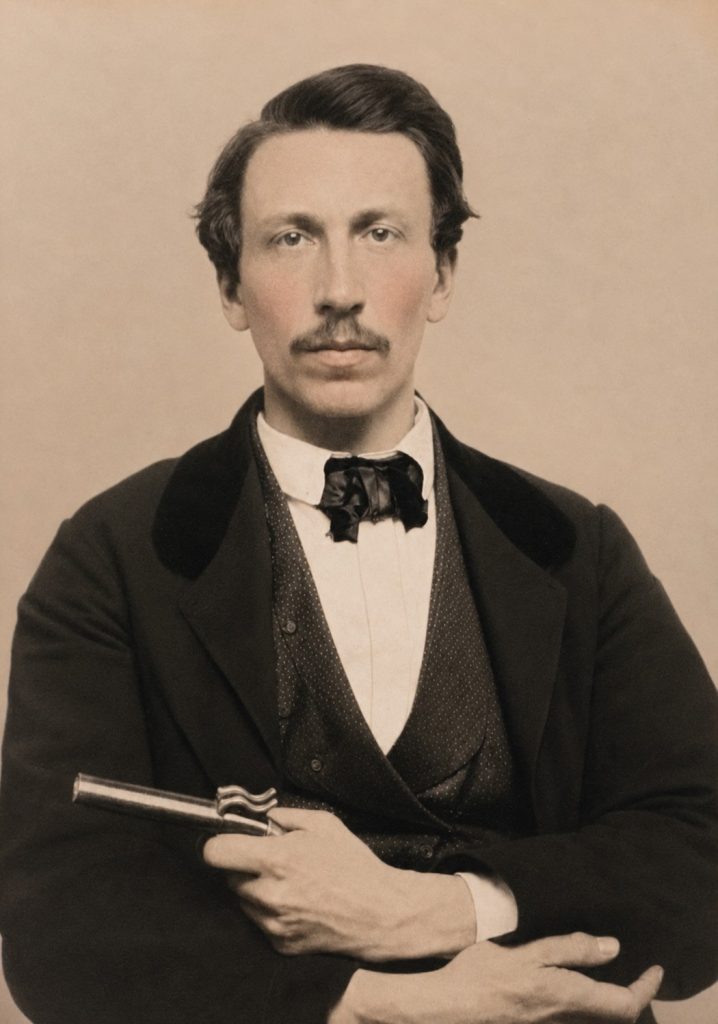
A nicely restored picture of a gentleman holding an Allen Double barreled Single trigger Percussion-pistol
The double-barreled pistol features a distinctive single-trigger mechanism that releases each hammer individually with successive trigger pulls when the shooter cocks both hammers.
However, under stressful conditions, a forceful trigger pull could easily release both hammers simultaneously, discharging both barrels at once. To avoid this problem, the shooter could cock and fire one hammer at a time instead of cocking both together. Although this approach eliminated the advantage of having two shots immediately available, it significantly reduced the risk of accidentally discharging both barrels at once.
The pistol features two parallel, deeply rifled .34-caliber barrels, available in lengths of 3, 4, 5, or 6 inches. The manufacturer’s name appears on the top rib between the barrels and varies according to the production period: ALLEN & THURBER, ALLEN, THURBER & CO., or ALLEN & WHEELOCK.
Ethan Allen produced these pistols exclusively during the Worcester manufacturing period, although he did not consistently mark the production location on the barrels.
Two examples of barrel markings. Top: ALLEN & THURBER WORCESTER, Bottom: ALLEN, THURBER & CO
An 6 inch barrel early version of the Double Barrel pistol having the main spring tension screws, and a late 3 inch barrel version without the tension screws
Early examples feature two U-shaped mainsprings with corresponding tension screws positioned next to the trigger guard. Allen soon replaced this arrangement with a simpler design that used two straight mainsprings and eliminated the tension screws.
Given that these pistols are muzzle-loading firearms, it is surprising that Ethan Allen did not incorporate integral ramrods into their design. This omission is particularly noteworthy because pistols bearing the Bruce & Davis or Spalding & Fisher markings—both generally believed to have been manufactured by Allen—featured integral ramrods.
COLLECTION PIECES
Bruce & Davis Double Barrel Pistol
Caliber:
34
Serial number
4
Length:
Barrel:10,2 cm (4"), Total:18,5 cm
Weight:
461 gr
Barrel marking:
BRUCE & DAVIS CASTSTEEL
Only the trigger guard, the trigger and the grip plates have a number
The Bruce & Davis pistols have very strong resemblance to Allen’s pistols and it is believed that these pistols where made by the Ethan Allen workshop since they bare all the characteristics. Bruce & Davis where distributers, not manufacturers, so this is another argument for the theory.
However, there are two noticeable differences between the Bruce & Davis pistol and the Allen pistol: The Bruce & Davis pistol has engraved side plates and grip backstrap. Furthermore, the pistol is equipped with a ramrod, which is a nice improvement compared to the Allen design.