Ethan Allen's Patent 13154
July 3rd, 1855
-
Key Idea
A rotating breech-block combined with a charge chamber that both loads the paper cartridge and mechanically breaks it during closing, while simultaneously improving sealing and cleaning of the breech.
-
Patent claim
Allen claims: (1) The combination of a rotating breech and charge chamber that opens for loading and closes to break and hold the cartridge while sealing the barrel. (2) A breech-block design that extends and acts as a scraper, reducing fouling and protecting the mechanism during operation.


UNITED STATES PATENT OFFICE.
ETHAN ALLEN, OF WORCESTER, MASSACHUSETTS.
IMPROVEMENT IN FIRE-ARMS.
Specification forming part of Letters Patent No. 13,154, dated July 3, 1855.
To all whom it may concern:
Be it known that I, ETHAN ALLEN, of Worcester, in the county of Worcester and State of Massachusetts, have invented an Improved Breech-Loading Fire-Arm; and I do hereby declare that the same is fully described and represented in the following specification and the accompanying drawings, letters, figures, and references thereof.
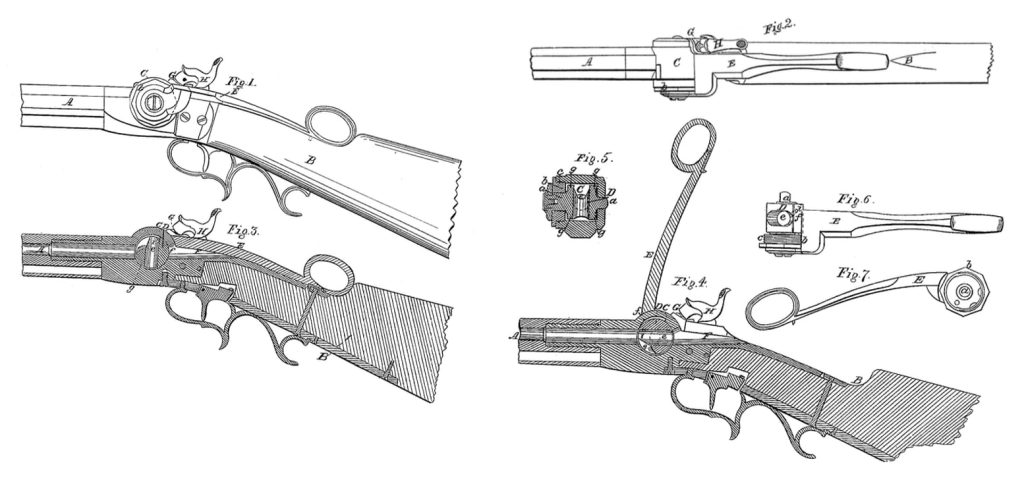
Of the said drawings, Figure 1 denotes a side view of that part of the barrel and stock of a rifle or gun to which my invention is applied. Fig. 2 is a top view of the same. Fig. 3 is a vertical, central, and longitudinal section of the same, the turning-block lever thereof being shown as closed down upon the stock. Fig. 4 is a similar section, in which the turning-block lever is represented as elevated to its highest position above the stock. Fig. 5 is a vertical and transverse section taken through the axis of the turning breech-block. Fig. 6 is a top view of said turning breech-block, its confining-screw, and turning-lever, to be hereinafter described. Fig. 7 is an inner side view of such block, screw, and lever.
In these drawings, A denotes the barrel of a common rifle or fire-arm, while B is the handle or stock of the same. The rear end of the barrel opens into a cylindrical chamber, C, within which there is placed a rotary charge chamber and breech-block, D, whose axis is arranged at right angles to that of the barrel.
The said breech-block is provided with journals a a, as seen in Figs. 5, 6, and 7, and it is attached by one of said journals to a lever, E, which extends from the journal and down on the top or upper side of the stock B, so as to constitute when closed thereupon a cover or protection to a grooved passage, F, formed in the stock and made to open into the cylindrical chamber C and in or about in line with the barrel A. That end of the chamber C through which that journal, a, which is immediately attached to the lever E passes is formed with a bearing, b, for such journal to revolve on, and has a confining male screw, c, by which it is either fastened to or unfastened from the remainder of the chamber C, as occasion may require, such chamber being formed with a female screw for the reception of such screw c. The other cylindrical journal of the block D fits into a corresponding bearing, d, formed in the other end of the chamber C.
The said turning-block D is provided with a charge chamber, e, which extends entirely through it or axially in one direction, and leads out of it in another or laterally, or nearly or about at right angles, to the first, as seen in the drawings. The segmental part f of the block D, I term the “breech,” its purpose being not only to cover the passage F and serve as a breech to the barrel when the axis of the charge chamber e stands in a vertical position, but to uncover the said passage F when said axis is in a horizontal position. The chamber e should have a diameter corresponding with that of the bore of the rear part of the barrel, or that part which is to receive the cartridge, such part in breech-loading fire-arms being, for a purpose well known, generally made of a diameter somewhat larger than the remaining part of the bore of the barrel.
The segmental breech part f of the block D has its external cylindric surface curved with a radius corresponding to that of the chamber C, while the remainder of the external curved surface of the block may be formed with a smaller radius, in order that there may be a space, g, between such part of the block and the internal surface of the chamber C, such space serving to prevent any carbonaceous matter that may be between the block D and the sides of the chamber C from so fouling the block as to materially impede its rotations. As the segmental part f projects beyond the remainder of the block, it serves, when put in movement, to scrape and clean the inside surface of the chamber C.
The percussion-nipple is represented at G, while the percussion-hammer of the lock is shown at H in the drawings. The flame-passages of said nipple may be made to communicate directly with the chamber e when the axis of said chamber e stands in a vertical position; or the percussion-nipple may communicate directly with it by means of a hole or passage, i, made through the segmental part or breech f.
In using my improved fire-arm the lever E is first to be raised above the stock, so as to bring the axis of the chamber e horizontal, or into line with the bore of the barrel A and the passage F. While the said parts are in such position a cartridge may be laid in the passage F and pushed from thence into the charge-chamber e and the bore of the barrel A. This having been done, the lever E is next to be turned down toward and upon the stock, and so as to move the axis of the chamber e into an angular position with respect to that of the barrel A. In consequence of the peculiar formation of the chamber e, such chamber, during its return or last-described movement, will so act in conjunction with the bore of the barrel as to bend and break the cartridge and expose its contents or powder, so that it may readily be ignited when a percussion-cap is exploded on the nipple. Under these circumstances it will be seen that the chamber e also performs the function of holding a part of the charge or cartridge while the remainder extends into the barrel.
A breech-loading fire-arm constructed in manner as above described has been found very efficient, and to possess many advantages in its operation not incident to most other arms of such description in use.
By the peculiar construction of the faucet-breech and the manner in which it is applied to the barrel the force of the explosion of a charge is caused not only to press the breech backward, so as to close the rear joint, but also to press the breech laterally, so as to close the joint between it and the screw c. When a charge is wholly placed in the barrel and in front of a faucet-breech, the force of the explosion of such charge tends to open the joint between the breech and the rear end of the barrel, causing more or less gas to escape out of such joint. Closing the joints by the force of the explosion is an important advantage, as the fouling of them by the gas or smoke is thereby prevented in a great degree, if not entirely, from taking place. The sides of the chamber C can easily be made of sufficient strength to successfully resist the explosion of the charge, whatever may be the direction in which it may operate, and, as the cartridge is broken apart at or near its middle, its contents are much better exposed to ignition from the fire of the priming, and are more thoroughly ignited than would be the case were such made to act against the rear end only of the cartridge.
I do not claim a rotary charge-receiver placed within or applied to a gun-barrel; nor do I claim a sliding or movable breech so applied to the barrel as to constitute not only a breech thereto and a means of uncovering the rear end of the bore of the barrel, and enabling a cartridge to be introduced into the same, but a contrivance for shearing or cutting off the rear part or end of the cartridge after the introduction of such cartridge into the barrel; nor do I claim a perforated rotary breech-cylinder so combined with or applied to a gun-barrel and entirely in rear of its charge-chamber that it (or its cylinder) may be capable of being rotated or turned in one direction, so as not only to uncover the rear end of such charge-chamber and present a passage or opening through which a charge may be introduced into it, but rotated back, so as to cover the rear end of the charge-chamber and constitute a breech thereto; nor do I claim a turning-lever and breech so applied to the rear end or part of a gun-barrel as to be capable of being turned up, so as to uncover such end sufficiently to permit a charge or cartridge to be introduced into the barrel; but
What I do claim as my invention is—
- So combining a rotary or movable breech and a charge-chamber together and with the barrel of a fire-arm that, not only when they (the said breech and chamber) are moved or rotated in one direction shall the breech uncover the passage into the barrel, and such charge-chamber be brought into a position to permit a cartridge to be passed into it and the barrel, but when they (the said breech and chamber) are rotated in the opposite direction, such breech shall be made to cover the passage into the barrel, and such charge-chamber, in conjunction with the barrel, be caused to bend, break, and hold such cartridge, as specified.
- The charge-chamber and breech-block D, provided with journals and bearings, as specified, extending the movable breech f beyond the block in manner as described, in order that not only may said breech serve as a scraper to the inside surface of the case C, but that the block may be protected from the injury and friction of the carbonaceous matter resulting from the explosion of a charge, as specified.
In testimony whereof I have hereunto set my signature this 28th day of March, A. D. 1855.
ETHAN ALLEN.
Witnesses:
R. H. EDDY,
F. P. HALE, Jr.