A closer look at the leather carrying equipment used with pepperbox pistols in the American frontier and Civil War eras.
An independent, reorganized adaptation of Robert Butterfield’s “The Holstered Pepperbox” (2003).
Pepperbox Holsters
Pepperbox Holsters: A Rare Survival from the 19th Century
During the mid-19th century, pepperbox pistols were popular personal-defense weapons, particularly in the United States. Their distinctive cluster of rotating barrels presented a challenge for holster makers, who had to accommodate a firearm quite different in shape from conventional single-barrel pistols and revolvers.
Pepperbox holsters were made primarily of leather and varied considerably in design, from simple open-top belt holsters to more elaborate flap-covered examples and saddle-mounted holsters. Many were individually crafted to fit a particular pistol, reflecting the practical needs and preferences of their owners.
Today, original pepperbox holsters are considerably rarer than the firearms they once carried. Their surviving examples offer valuable insights into 19th-century leatherworking techniques, methods of carrying concealed or openly worn firearms, and the everyday use of pepperbox pistols. Examining their construction, wear patterns, and distinctive features helps us better understand an often-overlooked aspect of early American firearms history.
In his publication “The holstered Pepperbox”, Robert Butterfield documented eight holsters, including examples with their original belts and accessories. Considered together, they provide a useful guide to identifying period holster designs and understanding how they were worn.
A young adventurer armed with a pair of bag gripped pepperboxes in socket-type holsters
Simple socket and sleeve holsters
The earliest and most straightforward form was a leather socket: a close-fitting sleeve into which the barrel cluster and action were lowered. These holsters generally left the grip accessible while protecting the rest of the pistol. Their lower ends could be closed with a leather plug.
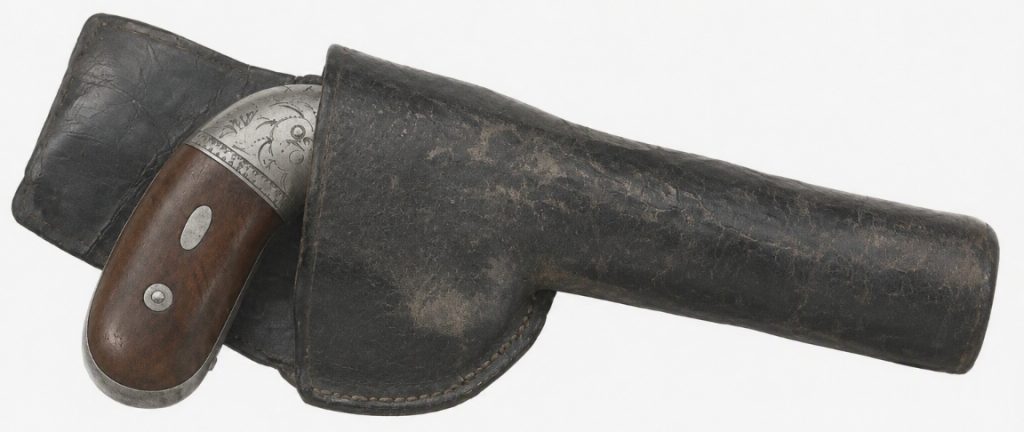
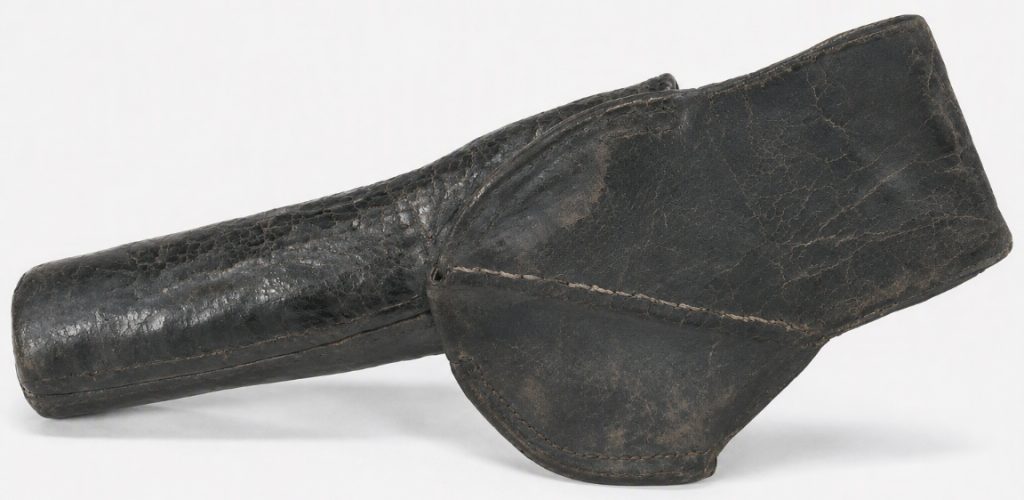
Heavy black leather dragoon socket
A nearly cylindrical, substantial black leather holster made for a large Grafton-pattern Dragoon pepperbox. It surrounds the barrels, hammer and trigger guard, with a stitched loop at the back for a waist belt.
The Allen Dragoon pepperbox in its holster
Dragoon holster - reverse view
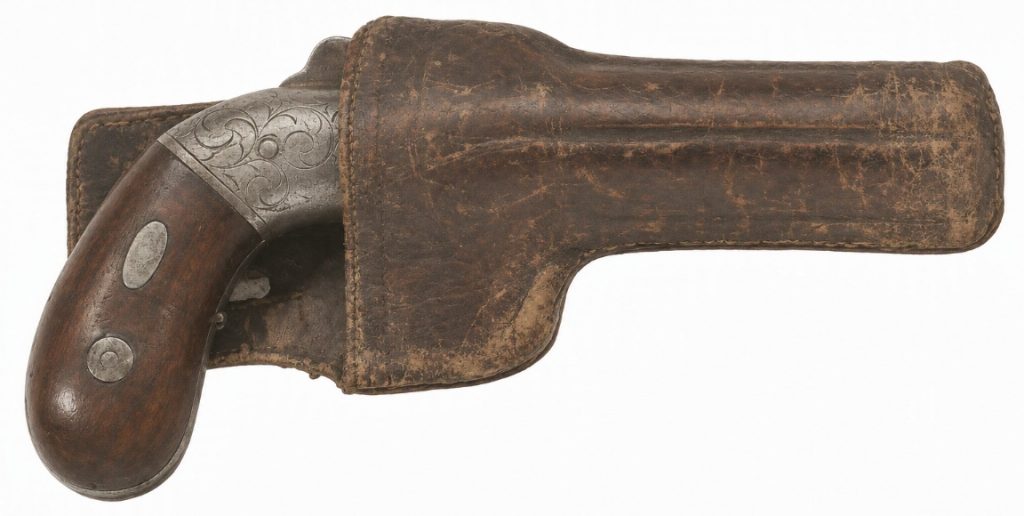
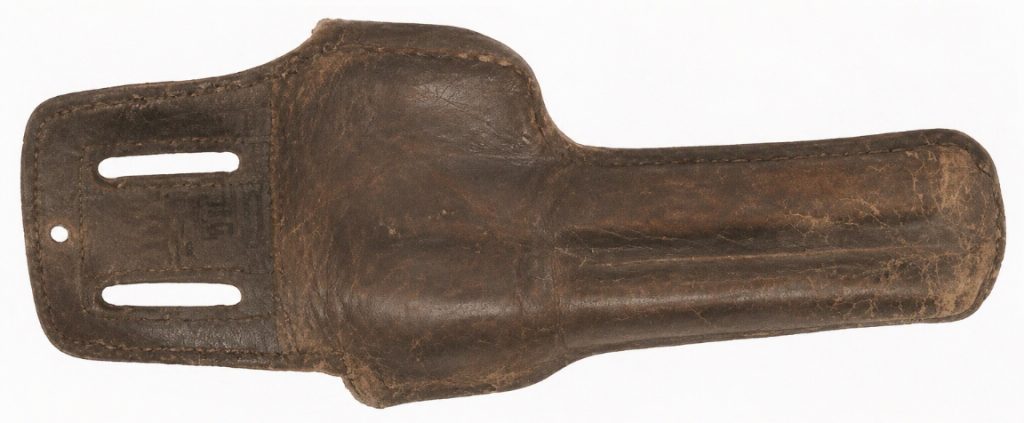
Light brown civilian socket
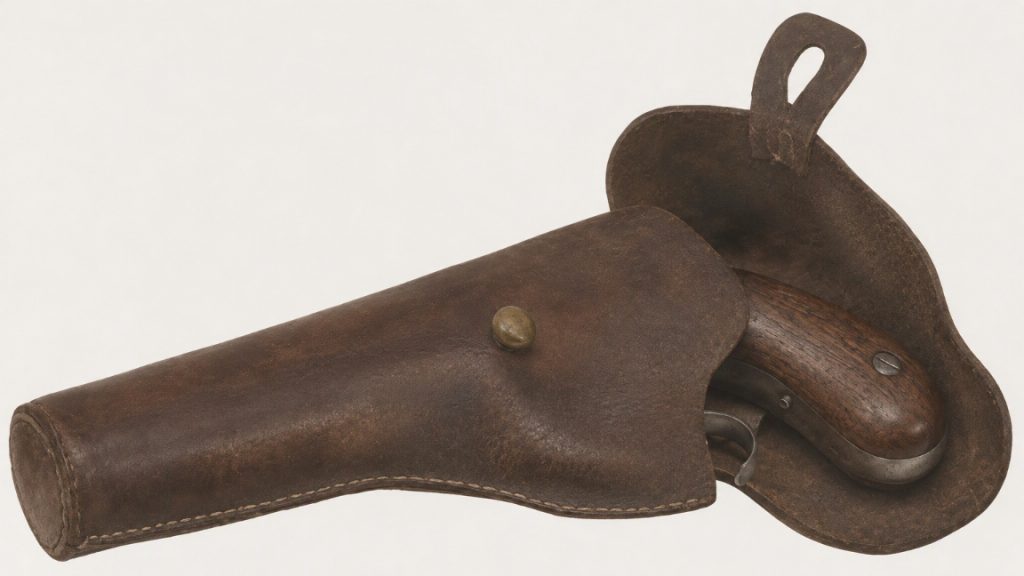
A lighter holster formed from one piece of leather around a standard-size Norwich ring-trigger pepperbox. A reinforced upper tab has two slots for a narrow belt. Its closed bottom and simple shape are characteristic of early civilian carry.
The Allen standard-size ring-trigger pepperbox in its holster
Holster - reverse view
Protective flap holsters and complete belt rigs
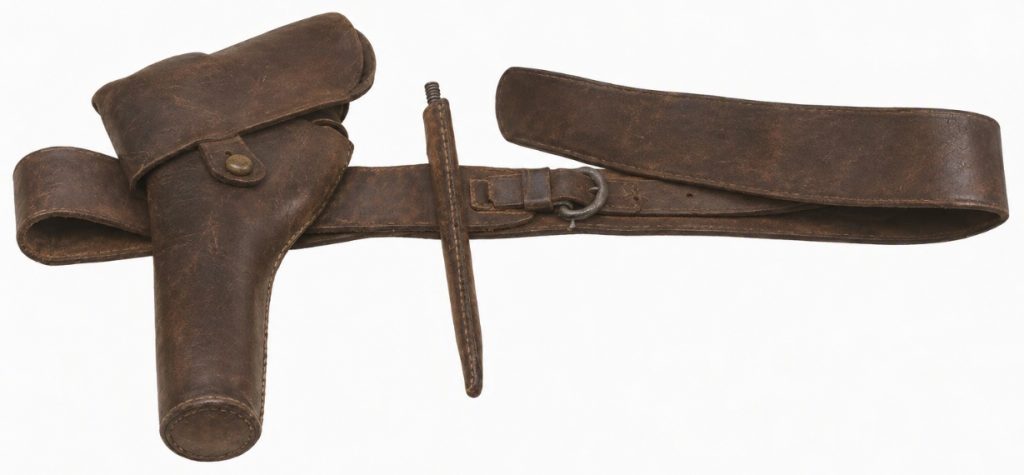
Flap holsters enclosed more of the pistol and offered additional protection against dust and exposure. One especially informative Worcester dragoon rig survives with a wide brown leather waist belt, holster, separate rammer pouch and rammer.
Its holster has a plugged bottom and a broad flap shaped to form a hood over the pistol, fastened by a large brass button. The belt uses a narrow inner strap and buckle concealed beneath the wider outer belt. The rammer pouch was once stitched to the belt, but after that stitching failed it was altered to slide over the belt instead. Repairs to the holster’s flap and belt-loop stitching also reveal a long working life.
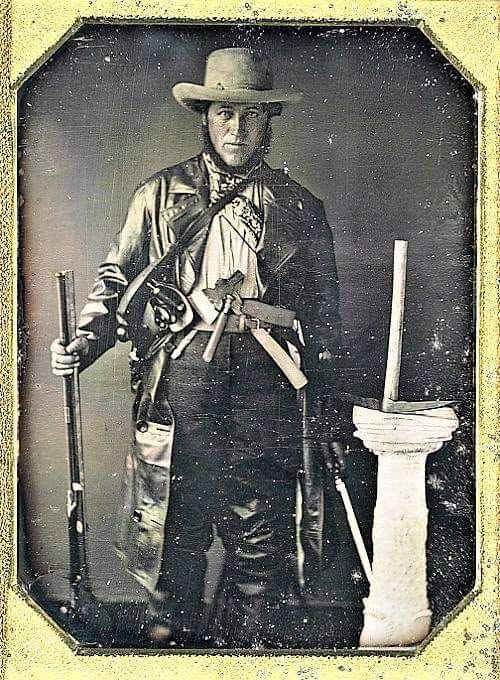
A contemporary daguerreotype of Dr. MacBeth depicts a comparable arrangement, including a flap holster and loading accessories. This visual evidence helps show how a complete outfit could be worn rather than simply stored.
Dr MacBeth in full gear, ready to cross the plain in the direction of California
Complete holster rig for Allen & Thurber Worcester Dragoon pepperbox
Civil War military-style holsters
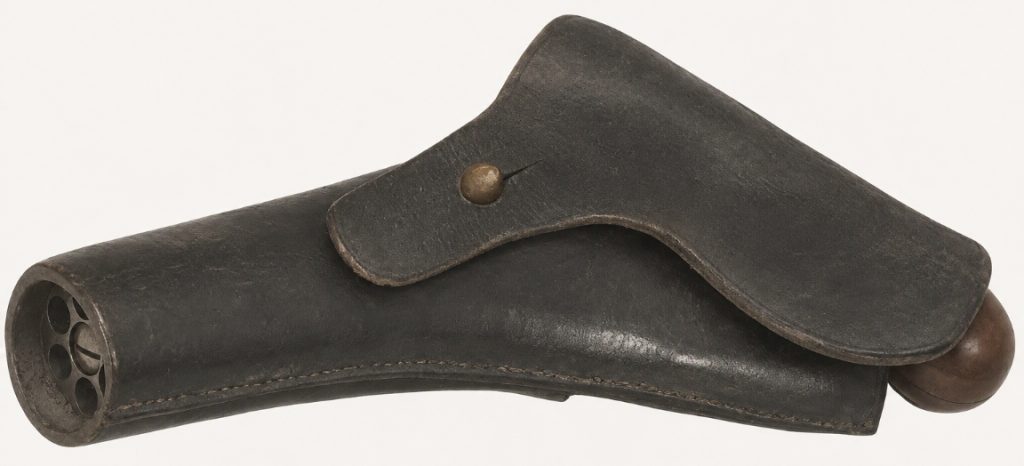
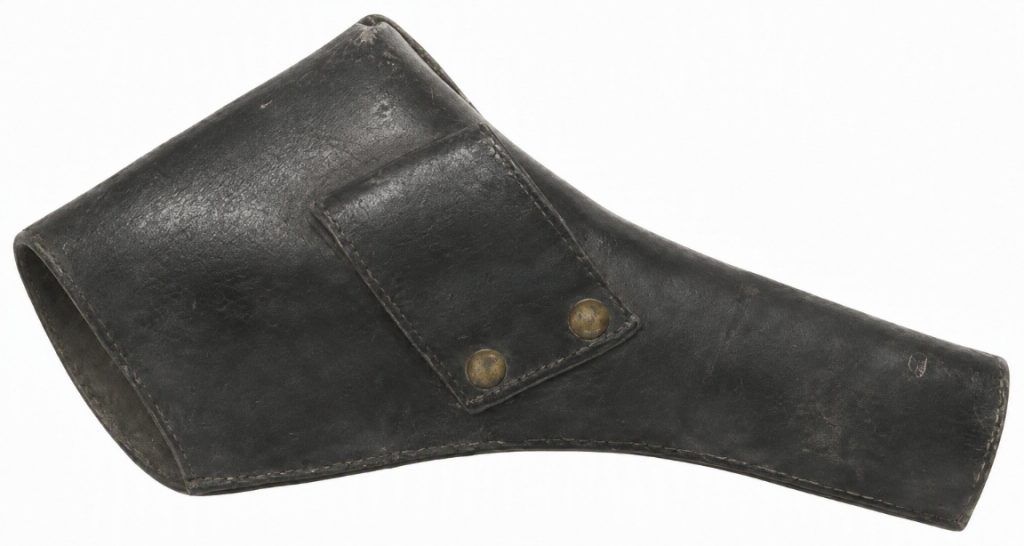
Two black leather flap holsters in Butterfield’s survey illustrate the use of pepperboxes as non-regulation sidearms during the Civil War. They differ in size and construction but share a military-style protective flap and brass-stud closure.
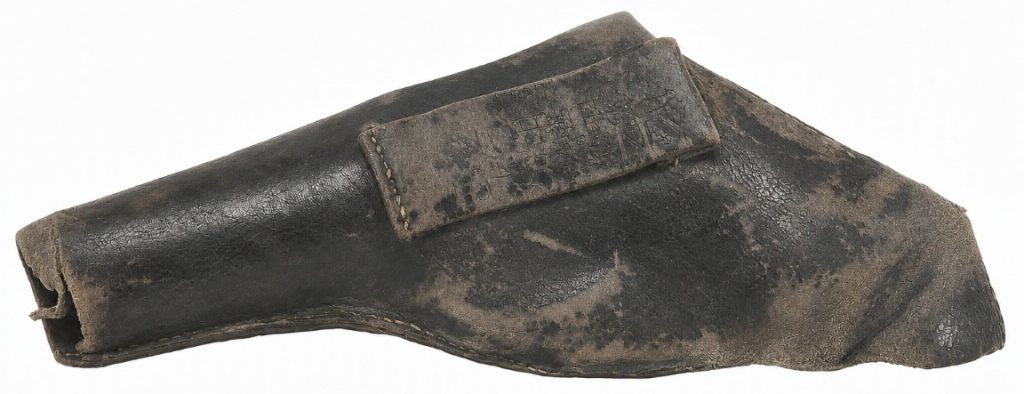
Large dragoon holster with an open toe
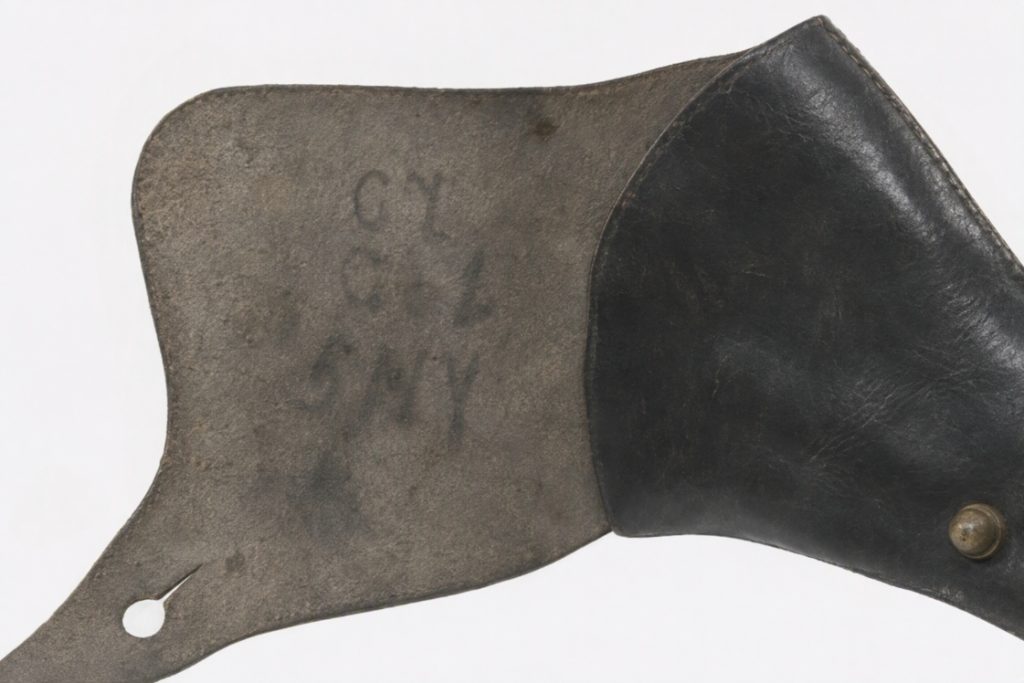
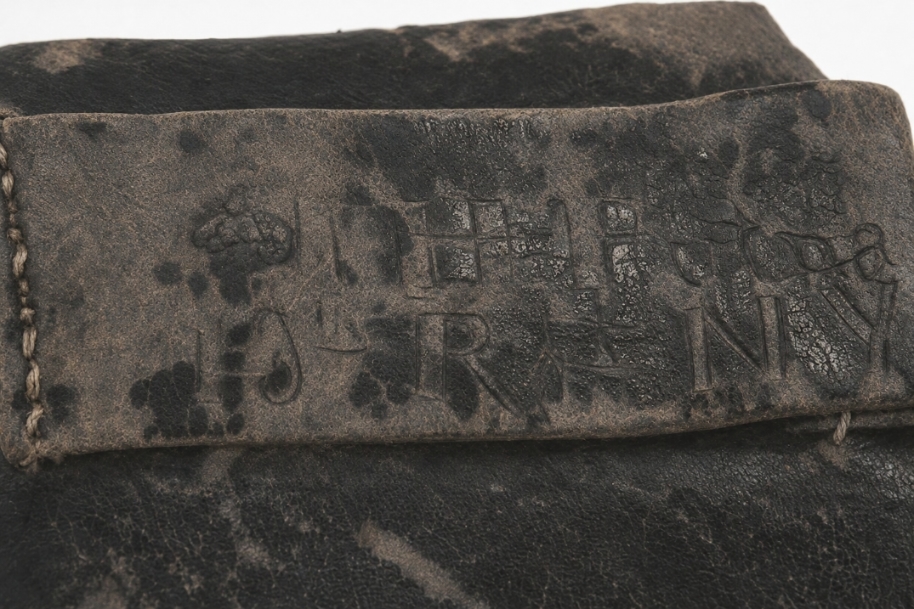
Made from heavy black leather, this holster has an angled belt loop to position the pistol for drawing. Unlike the closed socket patterns, its bottom is open, allowing water and debris to escape. The underside of the flap bears marks interpreted as “Co. L” and “5 NY,” although these have not been linked conclusively to a particular soldier or regiment.
Unit marking on inner flap
Allen Worcester Dragoon pepperbox military style Cival War holster
Holster - reverse view
Medium holster with a named belt loop
A comparatively light black leather holster that has gradually taken the contours of the pistol it carried. Its belt loop bears the inscription “I. H. Putnam” and “13 Regt. New York,” associated in Butterfield’s research with Lieutenant Israel H. Putnam of the 13th New York Infantry.
Regiment marking
Allen Worcester Standard-size pepperbox military style Cival War holster
Holster - reverse view
Pommel bags: carrying a pepperbox on horseback
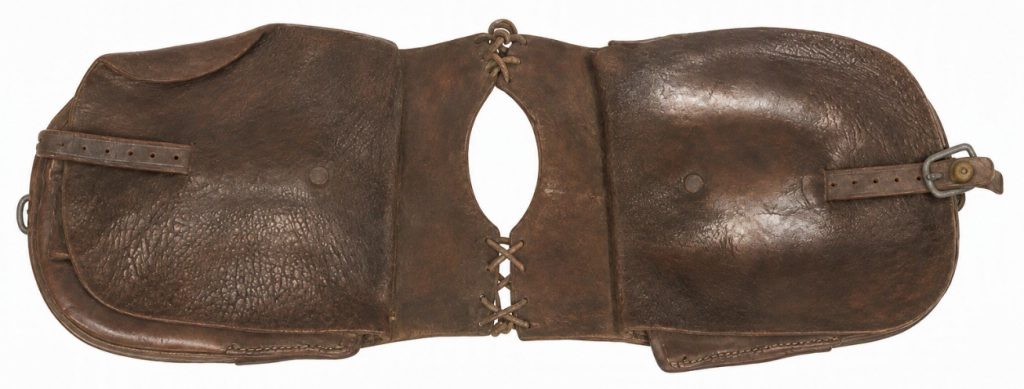
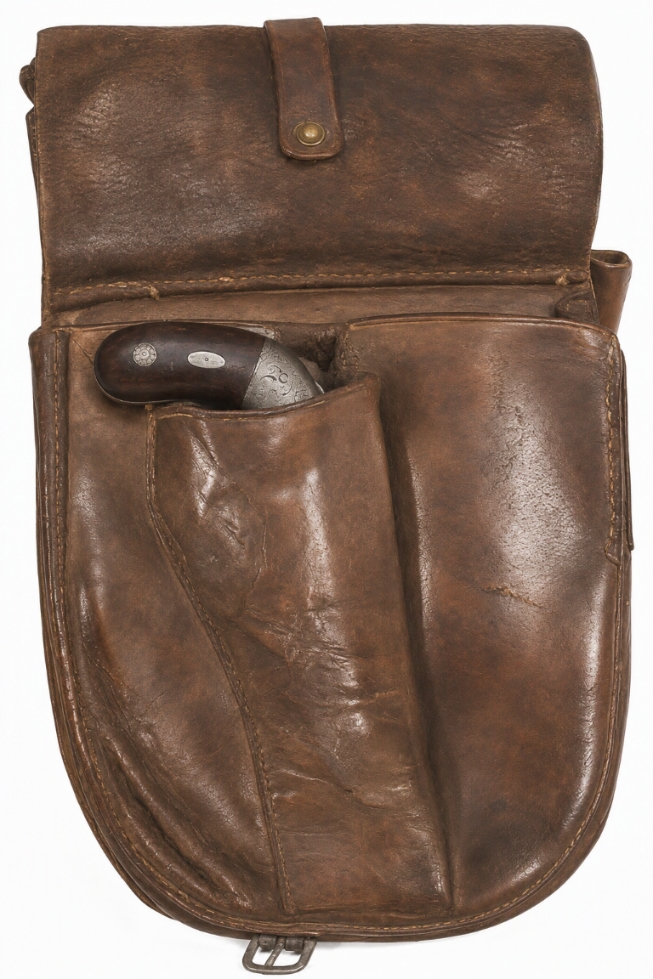
Pommel bags with pepperbox holster - Top side view
Not every pepperbox was worn at the waist. One remarkable example was housed in a small pair of leather pommel bags designed to hang over a saddle horn, keeping the pistol within reach of the rider.
The holster compartment is positioned unusually high and shaped to accommodate the broad body and sharply angled grip of an early Grafton medium-frame pepperbox. Butterfield initially found that ordinary revolvers did not fit the compartment properly. A comparable museum example helped establish the intended type of pistol; he later paired his bags with a suitably fitting pepperbox. The pistol and bags were not originally acquired together.
Allen Grafton Standard-size pepperbox in pommel bag holster
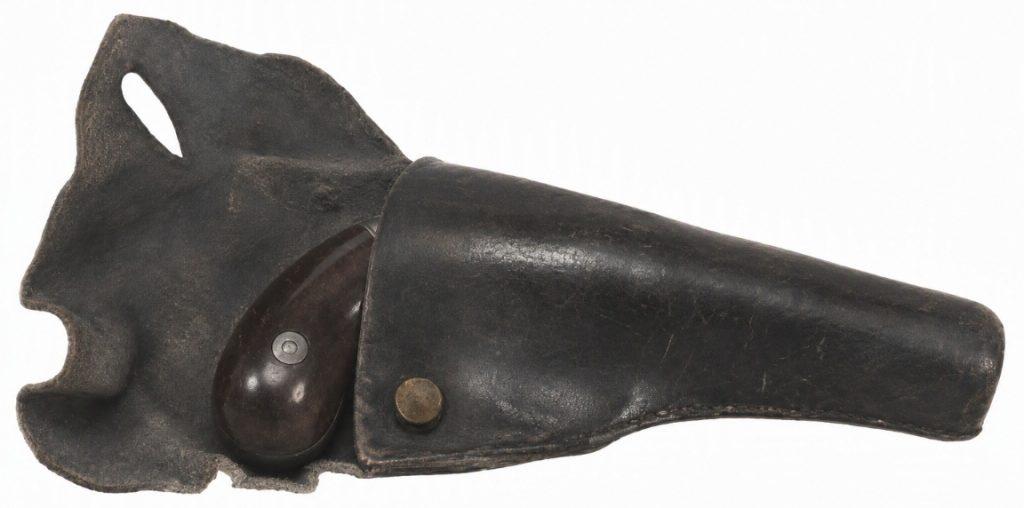
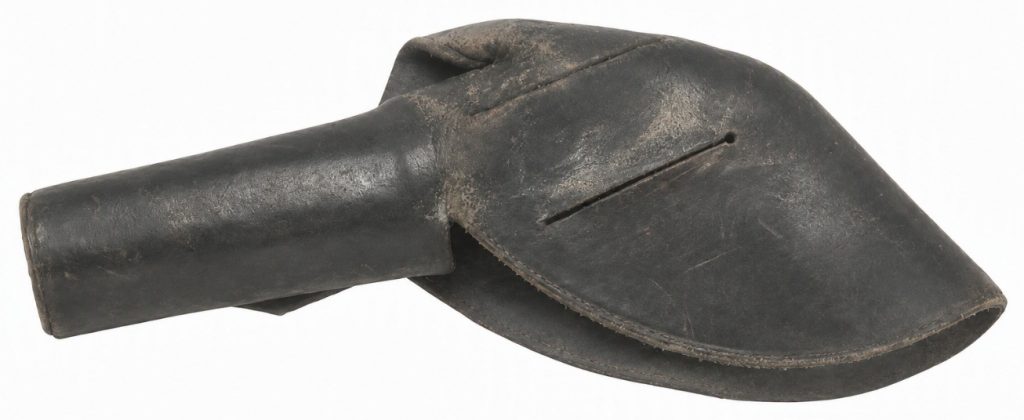
A pepperbox holster with a structural weakness
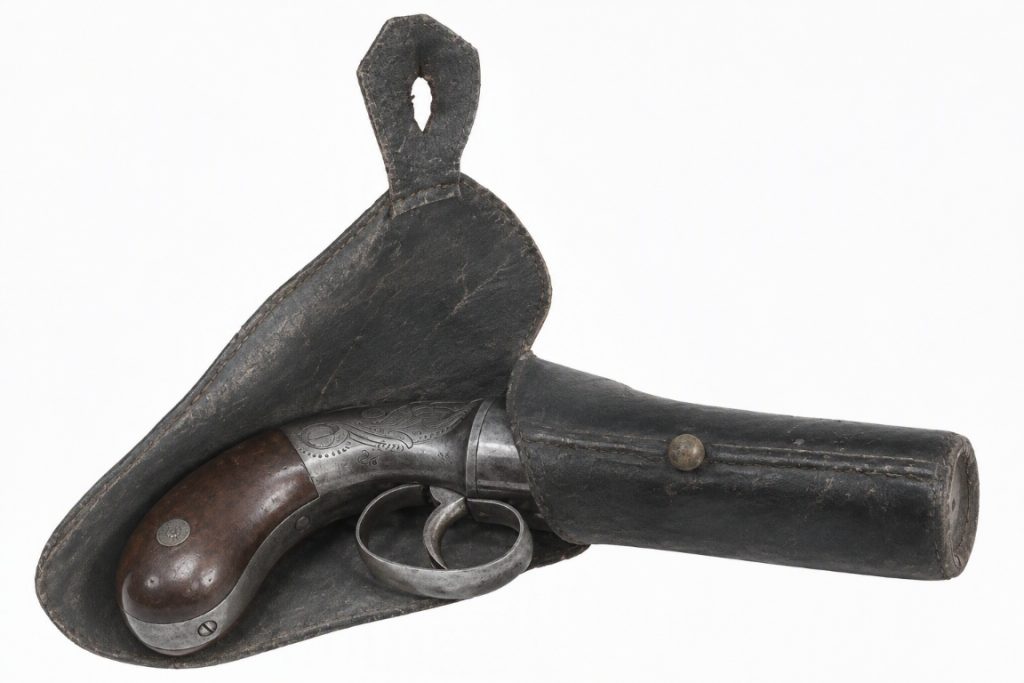
A medium-weight black leather example combines a socket-like body, a plugged bottom and a hooded flap secured by a brass stud. Instead of a separate reinforced belt loop, the belt passes through slots cut into the rear of the flap. That arrangement places the pistol’s weight on the flap itself. A tear where the flap joins the body demonstrates the weakness of this construction.
Holster - reverse view
A Manhattan pepperbox in the holster
Source
This webpage is an editorial adaptation, focused on holster design, of Robert Butterfield, “The Holstered Pepperbox,”American Society of Arms Collectors Bulletin 88 (2003), pp. 21–35. It is not a transcription of the source article.
The original photographs from the source article have been digitally colorized using AI.